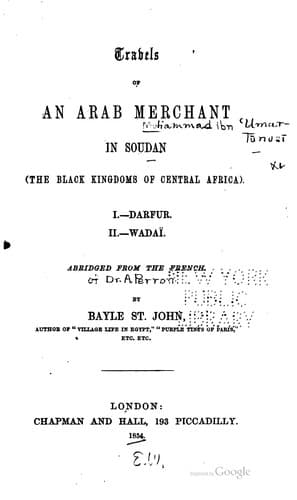
Travels of an Arab merchant in Soudan (the Black Kingdoms of Central Africa)Tūnisī, Muḥammad ibn ʻUmar
History
Travels of an Arab merchant in Soudan (the Black Kingdoms of Central Africa)
Tūnisī, Muḥammad ibn ʻUmar
Darfur (Sudan) -- Description and travel; Wadai (Sultanate) -- Description and travel
One of Saboun’s first cares was to destroy the terrible robbers
called Afrits, or devils. He thus ensured the safety of the roads,
so that during his reign a solitary woman, even covered with gold,
might venture into solitary places and have nothing to fear, except
from the Most High. But whilst the Sultan gave tranquillity to
others he remained himself disquieted. The thought that his brother
Asyl was abroad prevented him from taking rest, and embittered
all his pleasures. He waited impatiently until God should give him
an opportunity of freeing himself from fear. That nothing on his
part, however, might be wanting to effect this desirable result,
he invented a stratagem by which he decoyed Asyl from Darfur, where
he had taken refuge, and, having got him into his power, addressed
him in the same terms which he had used towards Ahmed, and then
ordered him to be put to death. Thus God delivered Wadaï. That
was a day of rejoicing such as the country had never seen.[31]
CHAPTER III.
The Sultan of Bagirmeh — A Court of Birds of Prey — Saboun
determines to make a War — March over the Desert — Encounter
with a Rhinoceros — Punishment of Cowardice — Veneration for
Sultans — A White Beard — The Crown purifies — Sultan Arous —
Anecdote — Attack on the Birny of Bagirmeh — Victory — Act of
Cruelty — A Bedawin Traveller — A new Route to the Mediterranean
— Schmed-el-Fari — The Sheikh’s Father at Fezzan — Caravans
— Want of Water — Price in the Desert — An obdurate Sheikh
— Death of Saboun.
When Sultan Saboun had fixed himself firmly on the throne he
repressed all evil actions, and did all the good he could. I shall
notice how he punished the culpable conduct of Haj-Ahmed, sultan of
Bagirmeh. This prince had excessively tyrannised over his subjects,
so that at length the Ulemas were excited to present themselves
before him and utter the complaints of the nation. He received them
graciously, and asked what was their business. An old man replied,
that they came to beg him to cause his servants to cease from
their excesses, and told a parable of a great tree which grew in
the midst of a field, and harboured birds of prey that devoured the
harvest. “Thy subjects,” he said, “are the harvest, thou art
the great tree, and thy officers the birds of prey. We fear lest the
tree be cut down; for the master of the harvest is God, who hateth
tyranny.” The good old man farther quoted some wise saws and some
verses from the poets, and also the words of the Prophet, to the
effect that an hour of justice is worth seventy years of prayer.
Public-domain text, read in full here on John Shaqi.
Reviews
Reviews
No reviews yet
Be the first to share your thoughts on this work.
Elsewhere in the archive
Join the Discussion
Join the discussion
Sign in to leave a comment or review.
Sign InorCreate an account