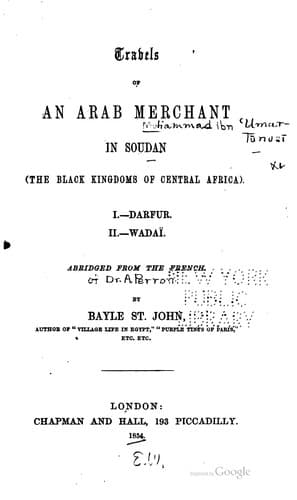
Travels of an Arab merchant in Soudan (the Black Kingdoms of Central Africa)Tūnisī, Muḥammad ibn ʻUmar
History
Travels of an Arab merchant in Soudan (the Black Kingdoms of Central Africa)
Tūnisī, Muḥammad ibn ʻUmar
Darfur (Sudan) -- Description and travel; Wadai (Sultanate) -- Description and travel
“Debauched scoundrel that thou art, traitor, libertine, impostor,
adulterer, oppressor, contemptible tyrant, brutal despot! dost
thou think that a being such as thou art is capable of acting as
sovereign chief and councillor, of governing men, and dispensing
justice? No! insensate was thy presumption; detestable were thy
thoughts. Thou capable of guiding the servants of the sovereign of
worlds! thou art not even fit to keep sheep.” He then proceeded to
accuse his brother of various acts of tyranny, of dishonouring modest
women, and of spilling blood, of overpassing the bounds set by God,
of trampling on all that was sacred, and concluded by challenging
him to disprove these charges.
Ahmed, with a bold, firm, and resolute voice, replied,—“Hold thy
peace! May God split thy mouth and confound thee, coward, rebel to
thy father, excommunicated from the pity of God! Certainly chance
has made a sad mistake in giving sovereign power to thee; but the
mistake will be repaired, let us hope. Dost thou think that I fear
the savage treatment thou art preparing for me? Do I not know that
the utmost of thy power is to say, ‘Let him be killed?’ Go;
to die is better than to be in the presence of a being so vile as
thou art.” The Sultan then addressed the Ulemas and the doctors of
the law, and said to them: “What is the judgment which the code
of Islam pronounces against this rebel?” They answered that he
must be put to death, or have a hand and a foot cut off. The text
of the words of God is as follows:—“He who revolts against
the Creator and his representative, and shall spread disorder and
rebellion in a country, shall die a violent death, shall be hanged,
or shall have a hand and a foot cut off, or _shall be exiled_.”[29]
Upon this the Sultan ordered the Mirwed, or iron tongs, to be
heated, and applied to the eyes of his brother Ahmed, who, being
thus blinded, was thrown into a prison, where he remained to the
end of his life.
In the same sitting Saboun pronounced judgment on the captive
viziers, ordering them to be put to death by the kabartou, or
executioners. These kabartou accordingly surrounded the unhappy men,
and felled them with iron clubs. The viziers contended who should
meet death in the bravest manner, and vied who should first present
his head. They feared to dishonour themselves by the slightest
act of timidity; for in Wadaï there is nothing so contemptible
as cowardice.
Having in this way got rid of the viziers who were related
to Ahmed, and having nothing to fear from their party, Saboun
reigned with justice and equity, and attracted the admiration of
his neighbours. Crowds came to contemplate him in his glory, just
as of old Pagan races used to throng the temples to behold some
great idol.[30]
Public-domain text, read in full here on John Shaqi.
Reviews
Reviews
No reviews yet
Be the first to share your thoughts on this work.
Elsewhere in the archive
Join the Discussion
Join the discussion
Sign in to leave a comment or review.
Sign InorCreate an account