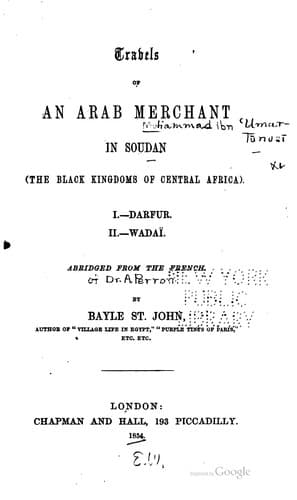
Travels of an Arab merchant in Soudan (the Black Kingdoms of Central Africa)Tūnisī, Muḥammad ibn ʻUmar
History
Travels of an Arab merchant in Soudan (the Black Kingdoms of Central Africa)
Tūnisī, Muḥammad ibn ʻUmar
Darfur (Sudan) -- Description and travel; Wadai (Sultanate) -- Description and travel
When everything was ready, the Sultan gave orders to commence the
march through the wilderness that separates the boundaries of Wadaï
and Bagirmeh. It is covered with lofty trees and vast expanses of
shrubs. In these savannahs are the repairs of lions and elephants,
and of the abou-kern, or unicorn, called in Egypt khartit, that is
to say, rhinoceros.[32] Saboun had sent people ahead to cut down
trees, and open for his troops a practicable road. Six Aguids,
each with four thousand slaves, formed the body of pioneers, which
preceded the main army by at least an hour. These slaves were armed
with hatchets, to cut down the trees and clear the way. Whilst they
were breaking through a thickset wood an enormous abou-kern suddenly
rushed upon the workmen, killed several whom he first met, and then
broke through the mass, slaying people right and left. Every one
fled, and the whole body of pioneers fell back upon the army, which,
soon being seized with a panic, took flight in all directions. The
Sultan soon found himself almost alone, and beheld the abou-kern
coming straight towards him. “What!” cried he, “is there no
one here that has the courage to fight this ignoble animal?” Now
it happened that there was a slave, named Ajmain, tall, well-built,
and vigorous, armed with buckler and javelins. He threw aside his
javelins, and stepped towards the animal with his shield and a long
knife. The Sultan looked on with anxiety. Ajmain waited until the
beast was near him, and then suddenly fell and allowed it to pass
over him. With a dexterous stroke of his knife, however, he succeeded
in ham-stringing the abou-kern, which rolled upon the ground. He
then fetched his javelin, and before the soldiers could come up
he had rendered their assistance unnecessary. Saboun ordered the
corpse to be dragged to an open place, and then calling together
his men, pronounced an angry speech against those who had been
most distinguished by cowardice. He ordered several of them to be
seized and executed on the spot. Among these was the governor of the
Jeataneh Arabs, in whose place he named the slave Ajmain. After this
bloody scene, Saboun said to his viziers and officers: “Whoever
of you flies at the time of combat, whatever may be the danger,
shall be put to death.” All humbly promised obedience. During
the whole war, indeed, the effect of these words was manifest; for
in the eyes of the Wadaïans obedience to the Sultan is a duty as
sacred as obedience to God and the Prophet. Indeed these people
often neglect their duties of piety, but never that which they
think they owe to the Sultan.
Public-domain text, read in full here on John Shaqi.
Reviews
Reviews
No reviews yet
Be the first to share your thoughts on this work.
Elsewhere in the archive
Join the Discussion
Join the discussion
Sign in to leave a comment or review.
Sign InorCreate an account