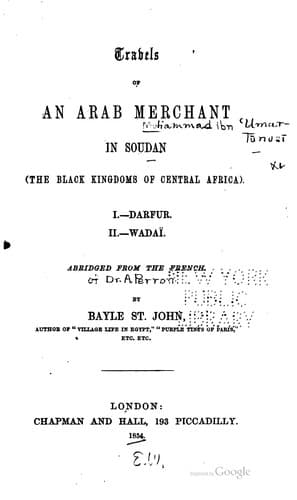
Travels of an Arab merchant in Soudan (the Black Kingdoms of Central Africa)Tūnisī, Muḥammad ibn ʻUmar
History
Travels of an Arab merchant in Soudan (the Black Kingdoms of Central Africa)
Tūnisī, Muḥammad ibn ʻUmar
Darfur (Sudan) -- Description and travel; Wadai (Sultanate) -- Description and travel
I shall relate an anecdote of the extreme veneration in which the
Sultan is held. It happened under the reign of Gaudeh. The wife
of one of his officers saw the sovereign pass, surrounded by his
courtiers, and in imperial dress. Age had whitened the beard of the
prince. In the evening, having returned home, the woman relating to
her husband what she had seen, said: “The procession was fine, the
Sultan was fine: what a pity it is that his beard is growing white
on both sides of his face! May God prolong the days of our master!”
Suddenly the husband fell upon his wife with violent blows,
saying:—“Ah! dost thou say that the beard on both sides of
our Sultan’s face is beginning to whiten? If any one heard thee,
respect for him would be gone. People would say that he is no longer
fit to go into battle.”
Having well beat her, he bound her, and left her in that spot
till the morning, when he presented himself before the Sultan, and
having related the adventure, added:—“I have left her there,
accursed woman that she is, bound hand and foot! Now, prince,
order what I shall do with her.”
The Sultan praised the officer for his good intentions, and presented
him with a garment; but he recommended him to forgive his wife this
one time, on condition that she should behave better for the future.
The veneration of the Wadaïans is encouraged by the Sultan, who
loves to be addressed with hyperbolical phrases and with extravagant
testimonies of respect. The people are persuaded that whoever is
raised to be Sultan of Wadaï immediately is illuminated by God,
becomes wise, is clothed with sanctity, even though before his
elevation he has given no sign of these things, and has lived
in debauchery and vice. The crown and sceptre are supposed to
purify. This belief is said to have arisen in the time of the
Sultan Arous, who had forbidden his name to be pronounced by any
person, either in his presence or out of it. In order to find out
whether any one infringed his order, he sent forth spies on all
sides—old women, children, youths—who were ordered to denounce
all delinquents. One day an officer of the police, made uneasy by
this strange order, went up to the top of a mountain where was a
cavern, into which he penetrated, and said in a low voice:—“The
Sultan Arous! the Sultan Arous! the Sultan Arous!” He believed
it impossible that he should be overheard by any one; but, by a
singular fatality, one of the spies had followed him unseen, and
overheard his words. Next day, accordingly, the officer was called
before Arous, who said to him,—
“Have I not forbidden thee, as well as others, to pronounce
my name?”
“It is true.”
“And wherefore hast thou done so?”
“Prince, I have not disobeyed.”
“Wilt thou swear to me that thou hast not done so?”
“I swear it.”
“Liar! thou didst go yesterday upon the mountain, and entered a
cavern and pronounced my name three times.”
Public-domain text, read in full here on John Shaqi.
Reviews
Reviews
No reviews yet
Be the first to share your thoughts on this work.
Elsewhere in the archive
Join the Discussion
Join the discussion
Sign in to leave a comment or review.
Sign InorCreate an account