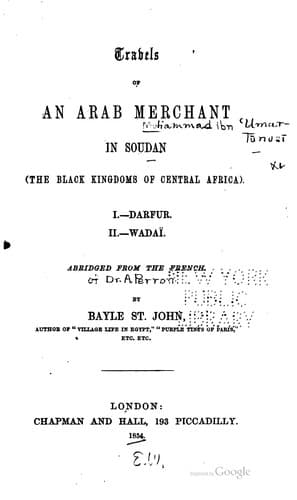
Travels of an Arab merchant in Soudan (the Black Kingdoms of Central Africa)Tūnisī, Muḥammad ibn ʻUmar
History
Travels of an Arab merchant in Soudan (the Black Kingdoms of Central Africa)
Tūnisī, Muḥammad ibn ʻUmar
Darfur (Sudan) -- Description and travel; Wadai (Sultanate) -- Description and travel
To return to Saboun. When the road of Aujilah was discovered,
he habitually sent his caravans by that route. In other cases he
despatched them by way of Egypt, and thence to Jalou, and thence to
Bengazi; for, by the way of Egypt, the road to Bengazi is shorter
than by the way of Tripoli. Saboun learned that his caravans easily
traversed Egypt, and that that country was governed by a just and
renowned prince. He accordingly sent letters and presents to the
Pacha, asking for his friendship; and Ibrahim, son of the Viceroy,
returned presents and a favourable answer, borne by two persons
of his suite and a Kawas. The Zaghawy of Darfur learned that the
Egyptian caravan was to pass near them, and that it was not in
strength sufficient to defend itself. They accordingly attacked
and pillaged it, but the Kawas escaped and carried the letter to
Saboun, who received him well and sent him back with presents, under
escort of a caravan. But the Zaghawy again attacked and destroyed,
or made prisoners, the whole. It was this that led to the conquest
of Kordofal by the Egyptians.
The Sultan Saboun, who had also sent an expedition to chastise
the Zaghawy, now fitted out an immense caravan for the Magreb. The
Shereef Ahmed El-Fasi went with it, bearing considerable riches. It
was ordered to take the route by way of Aujalou, and was protected
in the early part of its course by a strong escort. Then it entered
the desert, and wandered from the track. The supply of water was
rapidly spent, and it became so rare, that a single draught was
sold for seventy dollars (14_l_.). Many camels were killed, and
the water within them was also sold at a high price—at least so
I am assured by the Marabout Omar of Mesratta, and other of the
travellers. Many slaves and members of the caravan died of thirst.
The Shereef El-Fasi had an abundant supply of water. His companions
asked him for some to save them from perishing, but he refused. “I
am,” said he, “the head of a numerous family; this water is
my salvation and theirs. I have young children, and must preserve
myself for them. If they die by my fault, I shall have to answer
for it at the day of judgment. I will not be the artisan of their
misfortune.”—“Sell us water,” cried they, “at any price
you may name. We will give the acknowledgment, and pay exactly on
our arrival.” The Shereef remained inflexible.
Public-domain text, read in full here on John Shaqi.
Reviews
Reviews
No reviews yet
Be the first to share your thoughts on this work.
Elsewhere in the archive
Join the Discussion
Join the discussion
Sign in to leave a comment or review.
Sign InorCreate an account