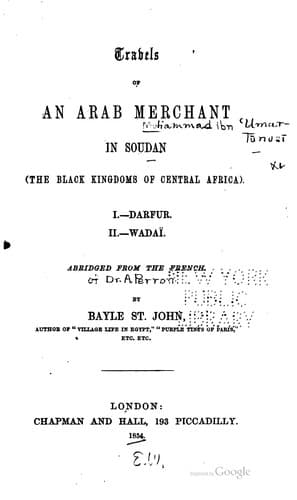
Travels of an Arab merchant in Soudan (the Black Kingdoms of Central Africa)Tūnisī, Muḥammad ibn ʻUmar
History
Travels of an Arab merchant in Soudan (the Black Kingdoms of Central Africa)
Tūnisī, Muḥammad ibn ʻUmar
Darfur (Sudan) -- Description and travel; Wadai (Sultanate) -- Description and travel
Wadaï is broader than Darfur, but not so long. Its territory is
much more generous. There is the same difference between them
as between to-day and yesterday, between the sun and the moon,
between a garden and a desert, between paradise and the great
fire. There are, it is true, some few places in Darfur the soil
of which something resembles that of Wadaï, but the greater part
of the former country is sandy, and almost deprived of water. The
Forians, therefore, who inhabit these deserts are puny, thin,
and have a yellow tint in their complexion; they are, so to
speak, always thirsty, and are compelled to portion out water as
if they were in a ship that has lost its reckoning at sea. But
in Wadaï, nearly everywhere there are springs of living water;
nearly everywhere there are leafy trees filled with the songs of
birds. From the province of Saba on the east, to the river which
forms the extreme boundary of the kingdom on the west, there is no
place where it is necessary to take in a supply of water. At each
village, during the twenty-two days which the Traject requires,
there are wells, and streams, and trees, and fields. The country is
nearly everywhere thickly peopled; and one village gives more profit
than ten villages of the neighbouring country. Compared to Wadaï,
Darfur may be said to be ruined. The same distance separates them
as separates the Pleiades from the earth. Whoever would depreciate
Wadaï would act like the legitimate wives of a harem, who look
upon a beautiful concubine just introduced, and exclaim in their
jealousy and bitter hatred,—“How ugly she is!”
The people of Wadaï, although less civilised than the Forians,
are of a more generous nature and a more hospitable character. All
the princes of Soudan admit that the administration of no country
is so well organised. The capital, Warah, is wonderfully situated
and laid out; it is shut in by mountains, so well disposed that
there are only two approaches, one of which could be defended by ten
men and the other by two. The soil of its territory is excellent,
neither too hard nor too sandy, whilst that around Tendelty reminds
one of the plains of Arabia, the foot of the traveller sinking in,
whilst dusty whirlwinds constantly arise. At Warah the dwellings
are better constructed than at Tendelty. At the latter place both
enclosures and houses are made of millet-stalks, except that the
Sultan has two little brick warehouses where his most precious
garments and weapons are kept, to preserve them from fire. But at
Warah most houses, with their enclosures, are of masonry, and the
palace of the Sultan is composed of a number of pavilions with solid
walls, and bow-windows with trellis-work. A kind of rampart, instead
of a hedge of thorns, surrounds it, as the halo surrounds the moon.
Public-domain text, read in full here on John Shaqi.
Reviews
Reviews
No reviews yet
Be the first to share your thoughts on this work.
Elsewhere in the archive
Join the Discussion
Join the discussion
Sign in to leave a comment or review.
Sign InorCreate an account