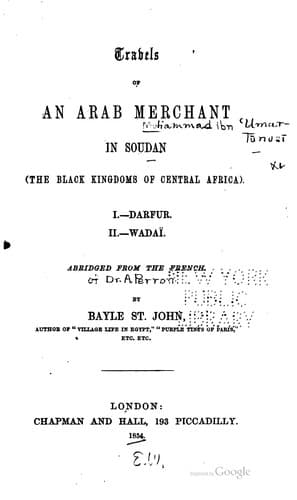
Travels of an Arab merchant in Soudan (the Black Kingdoms of Central Africa)Tūnisī, Muḥammad ibn ʻUmar
History
Travels of an Arab merchant in Soudan (the Black Kingdoms of Central Africa)
Tūnisī, Muḥammad ibn ʻUmar
Darfur (Sudan) -- Description and travel; Wadai (Sultanate) -- Description and travel
In Darfur there are no lands that are worth those of Wadaï,
except in the western provinces. But all the districts of the
latter country are rich and fertile, and well-peopled. In Darfur
most of the villages are nearly devastated by the violence and
tyranny of the governors. The few places that are well inhabited
are those whose chiefs have sufficient power to excite fear. Beyond,
all is desolation. The sufferings of the people, when I was there,
were extreme. Mohammed Fadhl was yet young; he passed his time in
pleasure, in riding, in drinking, and with women. His governors
overwhelmed the people; every one feared to possess wealth; there
were no longer any ranks or classes; the lowest kind of people were
promoted to the greatest honours, slaves became viziers, the most
respectable and revered men became humiliated.
Meanwhile the affairs of Wadaï prospered under the hand of Sultan
Mohammed Abd-el-Kerim Saboun. His justice and beneficence spread
over all; under his reign no one had to complain of injustice or
misery. He gave the bow to the bowman, the house to the mason,
to every one his place and his duty. He maintained Divine law
in honour. His equity penetrated to the most distant part of the
kingdom. He was loved by all, except by the wicked, whose hearts
were sick and whose souls were tainted and jealous. Wherefore
did destiny transform these joys into grief and sorrow? As a dog
seizes on its prey, it seized upon this prince in the full vigour
of youth. Too soon was the cup of misfortune poured out for those
who loved him. Everywhere had his arms triumphed. Everywhere he
drenched his enemies in the bitterness of death and desolation. He
subjected Bagirmeh, the dwelling of disorder and crime. He ruined
Tamah, the den of vice and irreligion. He shook the joints of the
Forians and their Sultan by the terror of his arms, and they feared
that the time of their expulsion was come. Saboun died in the year
1226 (A.D. 1811), after reigning only eight years, having done more
than other princes could have done in eighty. He lived too little
for his country. If his life had been prolonged, he would have
seized on Darfur and other provinces of Soudan, and have brought
back to those countries the beautiful age of the youth of the
universe. The days of his reign were days of smiling festival;
his anger was directed against evil, and he had no joy but in
goodness. Never did his subjects desire any other master than he.[35]
Let us now speak of the various inhabitants of Wadaï. The great
tribes of Dar-Seleih are the Massalit, the Mimeh, the Dajo, the
Kashmereh, and the Goran, or five primitive tribes; then come the
Koukah, the Jenakherah, and the Birguid. Each of these people
inhabits a particular country. The Massalit occupy the eastern
province, and have relations of interest, family, and origin, with
the Massalit of Darfur. They are of middle height and dark bronze
colour, and thickly cover a large plain country.
Public-domain text, read in full here on John Shaqi.
Reviews
Reviews
No reviews yet
Be the first to share your thoughts on this work.
Elsewhere in the archive
Join the Discussion
Join the discussion
Sign in to leave a comment or review.
Sign InorCreate an account