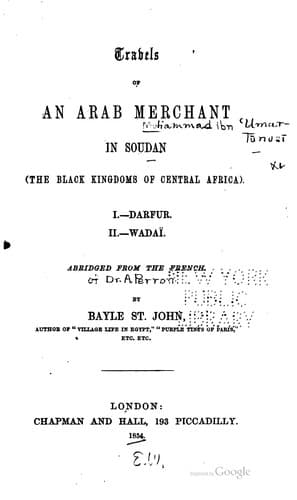
Travels of an Arab merchant in Soudan (the Black Kingdoms of Central Africa)Tūnisī, Muḥammad ibn ʻUmar
History
Travels of an Arab merchant in Soudan (the Black Kingdoms of Central Africa)
Tūnisī, Muḥammad ibn ʻUmar
Darfur (Sudan) -- Description and travel; Wadai (Sultanate) -- Description and travel
The Jengueh do not mark their cattle in the same way as other
nations. Every one knows their animals by the shape of their horns,
for each herd have them in a particular direction, which is given
them as soon as they begin to grow. Thus one master has the horns
of his flocks perpendicular, another horizontal, another makes
them advance forwards, another backwards, or to the right or left,
or crosses them or twists them in various ways. These facts are
certified to me by many individuals who have visited Jengueh, and
I have myself seen some of their cows with horns bent in the shape
of crescents.[43]
The Fertyts constitute an immense population, without any religion
whatever.[44] When they are reduced to slavery they adopt the
religion of those whose property they become. A year before my
departure from Darfur a great Ghazwah, or expedition fitted out
to catch slaves, set out under the command of a king or sultan
of slave-hunts, authorised by the Forian Sultan according to the
established forms. When the expedition was about to cross the
boundaries of the Fertyt country some Bedawin Arabs presented
themselves to the chief, and said that they had discovered a
considerable tribe which had not hitherto been visited, and praised
emphatically their beauty. The king, delighted with this information,
took a body of men and set out; but some days afterwards he came back
much disconcerted, bringing only a few slaves. I was afterwards
told that this tribe was a tribe of cannibals who eat people
alive. “When we reached their territory,” said a man who had
accompanied the expedition, “and appeared before the first village,
an immense crowd of the savages, with a weapon in the shape of a
sickle, very pointed and sharp as a razor, in their hands, rushed
fearlessly towards us. Behind them came an equal number of women,
each carrying on her head a great bowl filled with a thick paste. The
savages rushed upon us, each choosing a victim, and thrusting the
point of their weapons in the shoulder, made an enormous gash. The
blood gushed in abundance, and immediately the women came up with
their bowls, from which the men took large handfuls, and, having
dipped them in the blood, began to eat. They killed several of our
men and devoured them, so that we fled away in a fright.”
“And how,” said I, “do you call this tribe, whom God
confound?”
“They are called,” he said, “the Majanah.”
Public-domain text, read in full here on John Shaqi.
Reviews
Reviews
No reviews yet
Be the first to share your thoughts on this work.
Elsewhere in the archive
Join the Discussion
Join the discussion
Sign in to leave a comment or review.
Sign InorCreate an account