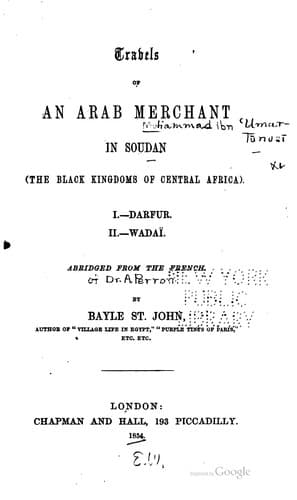
Travels of an Arab merchant in Soudan (the Black Kingdoms of Central Africa)Tūnisī, Muḥammad ibn ʻUmar
History
Travels of an Arab merchant in Soudan (the Black Kingdoms of Central Africa)
Tūnisī, Muḥammad ibn ʻUmar
Darfur (Sudan) -- Description and travel; Wadai (Sultanate) -- Description and travel
The regions of Pagan Soudan are remarkable for the fertility of
their soil and the purity of the air. The rains are abundant and
prolonged, and in some places cease only two months of the year. In
those southern countries are produced many kinds of tubercular plants
for food, one of which, called oppo, when cooked upon hot coals,
has the colour and the taste of a hard egg. Many fruit and other
trees cover the plains. The people, so savage, so inhospitable,
so far distant from the populations that are advanced in the
industrial arts, display, in the fabrication of certain articles,
a most wonderful address, giving them a finish worthy of the ablest
European artisan. They make for the kings and princes of Soudan
stools and seats of elegant shape and perfect finish. They also
manufacture, with a cleverness that reminds one of the English,
the knife-poniards which are worn tied to the arm above the elbow,
and also the iron-work of lances. I have seen among the Fertyt tubes
of iron, the work of which was of surprising purity and beauty,
reminding one of European industry. These tubes, which are used for
pipes, are not more than a span long, and are bent and twisted like
some European pipes; but are more elegant, more graceful, and are
so beautifully polished that they resemble silver. The bowls are
made of earthenware, adorned with iron circlets. They also make
bracelets and armlets of elegant manufacture.
The Fertyt make no kind of tissue, having no need of garments. The
men wear a kind of apron about a span in breadth, and the women
hide themselves only with leaves of trees, which are renewed
as soon as they wither. The tribe of the Jengueh is richest in
cattle. Their oxen are small, with long horns, and each individual
has his flock. These people, men and women, go entirely naked,
without apron or leaves. They are the most intrepid of the Fertyt,
the most audacious, and the best runners. They are so swift that
none can come up with them or escape them. They sleep both sexes
together, buried in ashes. This is the way the women in each family
prepare the beds: towards evening, when they have milked their cows
and finished their domestic labours, they take a large basket and
go through the country collecting dry dung, until they have made a
great heap before their hut. They then set fire to it and reduce
it to ashes. When they want to go to bed, the wife takes a piece
of butter and rubs her husband from top to bottom, after which he
creeps into his heap of ashes, where he sleeps. In the morning he
goes to the first pool of water and washes himself. What I cannot
understand in this habit is, that being thus buried in ashes,
the Jengueh can breathe without drawing in the dust through the
nostrils. Is this the result of habit? Do they leave their heads
out in the air, or have they any other particular way of protecting
themselves, against suffocation?[42]
Public-domain text, read in full here on John Shaqi.
Reviews
Reviews
No reviews yet
Be the first to share your thoughts on this work.
Elsewhere in the archive
Join the Discussion
Join the discussion
Sign in to leave a comment or review.
Sign InorCreate an account