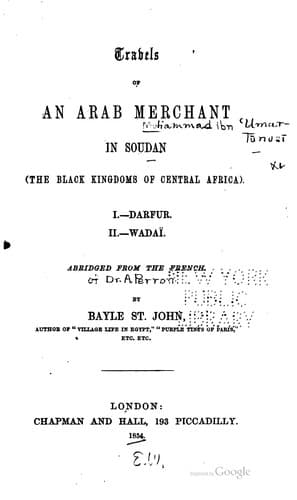
Travels of an Arab merchant in Soudan (the Black Kingdoms of Central Africa)Tūnisī, Muḥammad ibn ʻUmar
History
Travels of an Arab merchant in Soudan (the Black Kingdoms of Central Africa)
Tūnisī, Muḥammad ibn ʻUmar
Darfur (Sudan) -- Description and travel; Wadai (Sultanate) -- Description and travel
Two or three days afterwards, the Morocco man learned that there was
at Niffy an individual the amount of whose fortune no one knew. He
was the chief of the merchants of the city whom he had received so
coldly. This merchant called one of his inferior slaves, who acted
as a clerk, and said to him: “Said, go and buy the whole caravan
of that man, slaves, utensils, camels—everything.” Said dressed
himself in his best, and went, and was received by the Morocco man,
who thought he had to do with the chief of the merchants of the
city. After a few words, Said observed that he had a great number
of slaves to send to some of his correspondents, and had heard that
there was a large caravan to be sold in a mass. The bargain was soon
struck, at the rate of six thousand cowrie shells per head, and the
price of all the other articles was also fixed. The merchant only
kept a slave-woman, by whom he had had a child. The rest were led
away; and Said told the merchant to come in three days, and receive
payment. At the appointed time the Morocco man dressed, and went to
the house of the chief of the merchants, thinking that it was with
him that he had done business. He found him in a handsome mansion,
about which a considerable crowd was moving, whilst he himself sat
in a place apart, like a king, overlooking and directing all this
bustle. When the salutations had been exchanged, the man of Niffy
affected to talk with other persons on matters of business; add it
was not for some time that he condescended to address the stranger,
and say to him,—“Friend, what is the motive of thy visit?”
The other told him that it was to fetch the price of his slaves,
which he had sold to him three days ago. The head of the merchants
affected surprise, and said that he had not found it necessary to buy
slaves for a whole year, and yet had about ten thousand left. “Is
it possible, then, that there is any one else here besides thyself
who could have made this large purchase?”—“Certainly. I
have myself thirty clerks who have slaves, and yet the poorest of
them could have bought thy whole lot.” At this moment a slave
came up, and mentioned that he had bought so many slaves and so
much gold dust, that he had received so many thousands of shells,
&c. His master asked him if it were he that had bought the caravan
of the merchant, but he said, “No.” Then the other clerks were
called one by one, but all denied having heard of the business; so
that the merchant began to think that he had lost his caravan. At
last some one said that he had heard that Said had bought a whole
caravan. “May Heaven confound him!” exclaimed the chief of the
merchants; “he is always doing those kind of things: let him be
called.” Said soon presented himself, and admitted the purchase,
but affected to be angry with the Morocco man for speaking on such
a trifling business to his master, and then requested him to come
and be paid. Having handed over the amount of shells agreed on,
Public-domain text, read in full here on John Shaqi.
Reviews
Reviews
No reviews yet
Be the first to share your thoughts on this work.
Elsewhere in the archive
Join the Discussion
Join the discussion
Sign in to leave a comment or review.
Sign InorCreate an account