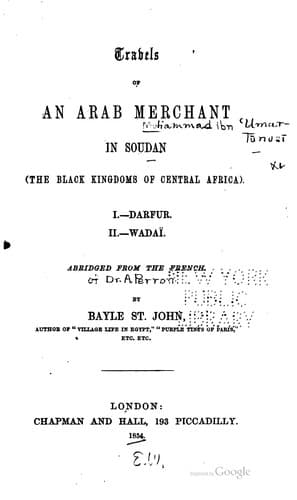
Travels of an Arab merchant in Soudan (the Black Kingdoms of Central Africa)Tūnisī, Muḥammad ibn ʻUmar
History
Travels of an Arab merchant in Soudan (the Black Kingdoms of Central Africa)
Tūnisī, Muḥammad ibn ʻUmar
Darfur (Sudan) -- Description and travel; Wadai (Sultanate) -- Description and travel
he said,—“May God and his Prophet preserve me from ever buying
again from such as thee! Didst thou consider me to be insolvent,
that thou shouldst thus go and complain to my master? I have bought
much greater caravans than thine without his knowing anything
of it.” The Morocco man was so humiliated by this proof of his
comparatively small importance, that he hastened to leave the city.
Let us now return to the history of the Fullans. Zaky easily made
himself master of Niffy. Struck with the beauty of the country,
and the wealth of the inhabitants, he resolved to build there a
seat of government.[48] He became so fond of the country that he
always returned thither after his excursions. Having rested a year,
and organised the government according to the principles of Islam,
he marched upon Afnou, which is celebrated for the beauty of its
slaves, and soon conquered it as well as Aghadez. Then he proceeded
against Bornou, the Sultan of which fled, as I have related, to
Kanoum. Now it was that Emin preached a sacred league against the
invader, whom he accused of having uttered false accusations against
Soudan, as an excuse for extending his authority. Soon afterwards
Zaky was defeated with great loss, and driven out of Bornou. This
was the first revival of courage amongst the princes of Soudan. It
is singular that the defeat of the Fellatahs coincided in time with
the first reverses of the Wahabites, which took place four or five
years after the period when the French definitively evacuated Egypt.
All these revolutions, which convulsed Central Soudan from Niffy and
Kashna to Bornou, were the consequences, as I have already suggested,
of the sedentary and tranquil life of the inhabitants. Ibn-Khaldoun
has already shown, in his great history, the effects of luxury in
rendering people effeminate. It may be objected that the developments
of industry and wealth in Europe do not produce similar results. But
it must be remembered that, in Islam, whatever refinement exists is
merely material, and has reference to the pleasures of the table,
the relation of the sexes, the laying out of fine houses, furniture,
valuable horses, singing, and domestic festivals. But there is
nothing done for the abstract sciences, nothing for the departments
of knowledge which are the domain of intelligence, the applications
of mathematics to arts and to war, physics, chemistry, medicine,
natural history, botany, and experimental studies. The knowledge
of the Muslim, when he has any at all, is confined to religious and
civil jurisprudence, according to the rite he has adopted. He adds
to this certain theological notions on the unity of God, and the
elements of analytical grammar. This is all that constitutes the
science of the Ulemas, the learned men of Islam, who attack all
those who meddle with human sciences as infidels and philosophers.
Public-domain text, read in full here on John Shaqi.
Reviews
Reviews
No reviews yet
Be the first to share your thoughts on this work.
Elsewhere in the archive
Join the Discussion
Join the discussion
Sign in to leave a comment or review.
Sign InorCreate an account