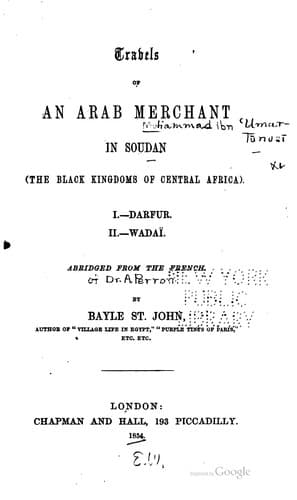
Travels of an Arab merchant in Soudan (the Black Kingdoms of Central Africa)Tūnisī, Muḥammad ibn ʻUmar
History
Travels of an Arab merchant in Soudan (the Black Kingdoms of Central Africa)
Tūnisī, Muḥammad ibn ʻUmar
Darfur (Sudan) -- Description and travel; Wadai (Sultanate) -- Description and travel
The people of Bagirmeh and Katakou remind me of the Italians in
the softness of their language, and the want of energy of their
character. The Birguid, the Tamians, and the Zagawah, are perfidious
and treacherous, like Greeks. Like them, they are base and crawling
when they fall in war into the hands of their enemies. The Fullans
resemble the Russians in their love of aggression and conquest, and
in the care they take to keep armies always ready for that purpose;
but in religious fanaticism they resemble the Spaniards, and for
a single prayer missed would put a man to death. The Bornouese
resemble the English in their somewhat coarse pride, in their
taste for luxury and show, and in their insatiable avidity; but
they are cowardly. Among Dajo and the Bijo, we find the natures of
the Fellahs, or peasants, of Egypt—the same laziness, the same
carelessness of their persons, the same dirt around them. They
submit, without a word, to all kinds of oppressions from their
superiors—to forced labour in every shape. They allow their
children, girls and boys, to be carried away and made to work,
without ever thinking of means of escape from unjust caprice,
or of freedom from odious servitude. This resignation is greater
still among the Berti and the Massalit, who are richer and more
numerous. They turn pale at the slightest glitter of warlike
weapons, and at sight of a few armed men tremble like sheep in
presence of the wolf. A single Forian, with a stick in his hand,
can drive before him two hundred men of Berti.
CHAPTER VII.
Trade, by whom followed — Exports of Darfur — Price of Slaves
— Imports — Value of Metals — The Tallari — Commerce of
Wadaï — Pledges of Love — A lost Moudraah — Value of Salt —
Manufactures — Interchange of Services — Burials — A Happy
Country — Counting Prayers — Forian Character — Occupations
of Women — Government of Wadaï — Offices — Audiences —
Kabartou — Servility — Punishments — Prisons.
The Sovereign Disposer of all things has placed commercial men
neither among the great nor among the poor, but among the middle
classes. By their means the productions of various countries are
spread abroad, and relations are established between nations. The
most virtuous of men, the holy Prophet of God, Mohammed himself,
honoured this profession, and went on trading journeys into
Syria. His example has been followed by men of various climates;
among others, the people of Soudan, being in possession of many
natural productions, and in want of manufactured articles, have
naturally taken to trade.
From Darfur are exported slaves, gum, elephants’ teeth, tamarinds,
various kinds of medicaments, ox-hides, from which are made the
great square leathern bags, called in Egypt rai,[49] and black and
white ostrich feathers. All these things are easily sold in foreign
countries, where there is a great demand for the principal articles.
Public-domain text, read in full here on John Shaqi.
Reviews
Reviews
No reviews yet
Be the first to share your thoughts on this work.
Elsewhere in the archive
Join the Discussion
Join the discussion
Sign in to leave a comment or review.
Sign InorCreate an account