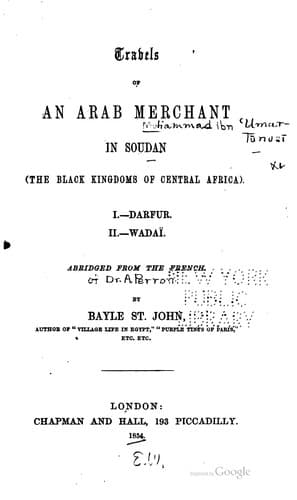
Travels of an Arab merchant in Soudan (the Black Kingdoms of Central Africa)Tūnisī, Muḥammad ibn ʻUmar
History
Travels of an Arab merchant in Soudan (the Black Kingdoms of Central Africa)
Tūnisī, Muḥammad ibn ʻUmar
Darfur (Sudan) -- Description and travel; Wadai (Sultanate) -- Description and travel
Darfur imports merchandise which is generally without value or
utility for civilised people, especially karaz, or glass ware,
beads, &c., of various kinds, used as ornaments by the women. Some
kinds serve the purpose of hidden jewellery, if I may so express
myself. They wear several strings of them round their waist, the
jingling of which is supposed to stimulate amorous sentiments. Women
know how to communicate their feelings and desires to their lovers
by this curious language. The Forian women also wear, for the same
purpose, bracelets and anklets, with little bells, which tinkle as
they move. Coral, artificial and otherwise, is also sent to that
country for the manufacture of ornaments. The red caps worn by the
men are brought from Fez. The slave-merchants take to Darfur some
fine cotton stuffs, each piece of which is of sixty cubits. They cut
them into lengths of twenty cubits in the country where they buy,
and having had them dyed, take them away, and generally procure
a slave for each cut. A coarse mixture of silk and cotton is also
used in the barter for slaves, as are also several other kinds of
stuffs. Foreign asses, such as those of Egypt, are highly esteemed
in Darfur. _A Forian will give ten slaves for one ass!_[50]
They take to Darfur a good deal of sunbul or nard (_Spica Celtica_),
sandal wood, myrtle-leaves, cloves, coffee, and soap. With the
exception of the two last-mentioned articles, which are imported in
very small quantities, all these substances are reduced to powder
for cosmetics. Old vessels of copper, such as worn-out caldrons,
are sent to Darfur, and sold at a high price, to be mixed with zinc,
for making anklets and other ornaments. Yellow copper, in leaves, is
very rare, being used only to make the frontlets for horses. Latten
wire is much sought after, to ornament the shafts of lances. Needles
are very dear; a slave is given for a thousand. Foreign razors
bear also a high price; those made in the country skinning rather
than shaving. Turkish saddles, Mamlook stirrups, coats of mail, and
straight swords—for the Sultan only can use the scimitar— are
in request. To these straight swords are attached silver pommels,
in which are hollows containing pebbles, that produce a jingling
sound. When thus ornamented, a sword is called a garlic-head.
One of the most profitable articles of importation is the tallari,
or Spanish douro—the pillar-dollar. A slave is bought for eight
or ten dollars (from 2_l_. to 2_l_. 10_s_.). Bars of sulphur are
also very valuable in Soudan; so is writing-paper; and the sale
of Muslim books of jurisprudence, and of the Haddyth, or book of
traditions of the Prophet, is very advantageous. Brass inkstands,
with cases for pens attached, and pen-knives, are sold to the
Fakihs. Muslin for turbans, shoes, and yellow slippers for women,
are only sent to private orders. Most of these articles are supplied
by Egypt to Darfur.
Public-domain text, read in full here on John Shaqi.
Reviews
Reviews
No reviews yet
Be the first to share your thoughts on this work.
Elsewhere in the archive
Join the Discussion
Join the discussion
Sign in to leave a comment or review.
Sign InorCreate an account