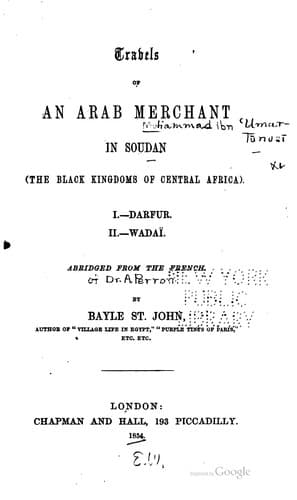
Travels of an Arab merchant in Soudan (the Black Kingdoms of Central Africa)Tūnisī, Muḥammad ibn ʻUmar
History
Travels of an Arab merchant in Soudan (the Black Kingdoms of Central Africa)
Tūnisī, Muḥammad ibn ʻUmar
Darfur (Sudan) -- Description and travel; Wadai (Sultanate) -- Description and travel
The object of these customs is to repress the spirit of
insubordination,—to prevent its being supposed that there is
no difference between a sovereign and his subject, and thus to
prevent revolt. The servility of the people is so great that it
is not allowed amongst them to praise any one whatever. No one is
worthy of praise but their Sultan. It is not even allowed for a
subject to bear the same name. Under the reign of Saleh the people
of the provinces came to present themselves to that Sultan. The
interpreter, according to custom, had taken down their names
beforehand in a hurry. Among the visitors was one named Saleh, so,
in addressing him, the interpreter said,— “The Sultan salutes
Fakih Saleh.” At these words the Prince frowned, and uttered a
cry like that of a peacock. The interpreter felt his danger, and
quickly said,—“The Sultan salutes thee, Fakih Fakeh.” Near
Warah there was a well called the well of Saboun; when that Sultan
came to the throne it was called the well of Ochar.
The Sultan never drinks water twice following from the same
place. The water-carriers of the palace come suddenly upon one of
the wells, and beat away with whips those who are near it, and then
fill their jars. It is feared that some one may bewitch or poison
the water, which is put carefully in jars, enough for twenty days
being taken at a time.
No person is allowed to appear before the Sultan inside his palace
with a turban, with shoes, or even fully dressed. He takes off
something at each gate, until he is reduced to a single garment
round the middle. When the Sultan calls any one he uses the words,
Ya Abd!—“Oh slave!” which appellation is received with
pleasure. No one is allowed to see him face to face in his own
dwelling, for he always speaks from behind a partition or curtain.
When a debtor delays payment too long in Wadaï, the creditor,
on meeting him, whether alone or in company with others, draws
a line round him and says, “I summon thee in the name of God
and his Prophet, in the name of the Sultan, and the mother of the
Sultan, and the judges, not to overpass this line until thou hast
paid me.” After this the debtor dare not pass until he receives
permission or pays his debt, otherwise he may be severely punished.
It is customary in all Wadaï to give to any pretty girl the surname
of Habbabeh, the title of the first wife of the Sultan. After this
she cannot be married until she has been presented to the Sultan,
who has the option of keeping her for his harem or of sending her
back to her father.
Few persons occupy a lofty position for more than two years. After
that they are removed to other posts or fall into disgrace. There
is an extensive system of inspection organised. Malversation is
severely punished.
Public-domain text, read in full here on John Shaqi.
Reviews
Reviews
No reviews yet
Be the first to share your thoughts on this work.
Elsewhere in the archive
Join the Discussion
Join the discussion
Sign in to leave a comment or review.
Sign InorCreate an account