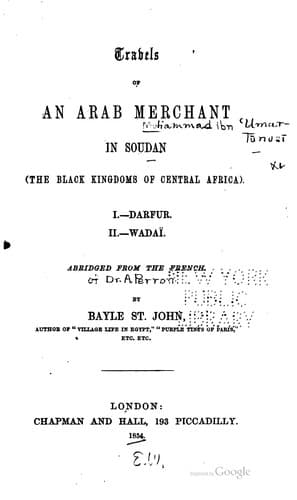
Travels of an Arab merchant in Soudan (the Black Kingdoms of Central Africa)Tūnisī, Muḥammad ibn ʻUmar
History
Travels of an Arab merchant in Soudan (the Black Kingdoms of Central Africa)
Tūnisī, Muḥammad ibn ʻUmar
Darfur (Sudan) -- Description and travel; Wadai (Sultanate) -- Description and travel
At the extremity of the Fasher, opposite the palace, is a little
eminence called Thoraya, on the top of which is a building in which
are deposited the great kettle-drums of the Sultan. At Wadaï the
covering of these drums, instead of being performed with ceremonies,
as at Darfur, is executed in secret. Whenever the Sultan appears
upon the Fasher the music of Thoraya resounds, and at the same time
is heard the crash of the baradieh, the rolling of the tambourines
of the Kabartou, the trumpets of the Turguenak, the clashing of
the iron rods, the clapping of hands. It is impossible to conceive
a greater clamour. On Friday, after the salutation, whoever has any
complaint to make proceeds in the following manner:—He first strips
his garments off his shoulders and ties it round his loins; then he
walks in front of the spectators from right to left, stooping down
and clapping his hands. He does this until he succeeds in attracting
notice. If the matter is of minor importance the Sultan sends the
plaintiff to the Kamkolak; if otherwise, he himself decides.
The respect of the Wadaïans for their Sultan is a kind of
adoration. They never lay any business before him without repeating
the first chapter of the Koran, and praying God to grant him victory
and long life. Everything of value is reserved for him. No vizier
or functionary is allowed to wear silk on his person, or in the
housings of his horses. He must not have a saddle covered with cloth,
nor gilded, nor embroidered in gold, nor garnished with silver. No
one but he, moreover, is allowed to make use of a carpet to sit
upon. No man or woman is permitted to have ornaments of gold,
nor to have fans of ostrich feathers, nor even of coloured paper,
as in Europe. Both sexes indifferently wear clothes, black or white,
of cotton, linen, or coarse muslin. All ornaments, even of the wives
of viziers and emirs, are of silver; the middle classes wear copper,
and the poor iron. If any one were to transgress this sumptuary law,
whatever might be his rank, he would be put to death without mercy.
Public-domain text, read in full here on John Shaqi.
Reviews
Reviews
No reviews yet
Be the first to share your thoughts on this work.
Elsewhere in the archive
Join the Discussion
Join the discussion
Sign in to leave a comment or review.
Sign InorCreate an account