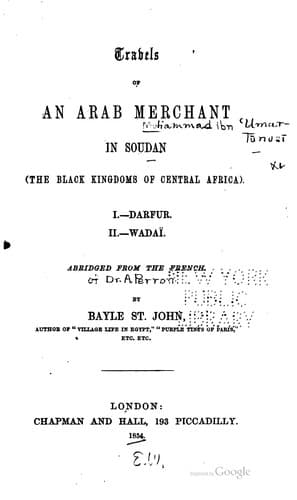
Travels of an Arab merchant in Soudan (the Black Kingdoms of Central Africa)Tūnisī, Muḥammad ibn ʻUmar
History
Travels of an Arab merchant in Soudan (the Black Kingdoms of Central Africa)
Tūnisī, Muḥammad ibn ʻUmar
Darfur (Sudan) -- Description and travel; Wadai (Sultanate) -- Description and travel
In Wadaï the punishments determined by the religious laws
are applied according to the very terms of the Koran.[53]
The Sultan has also the right to condemn to death, to stripes,
or to imprisonment. When he wants to put a criminal to death, he
says to his Kabartou, “Take that man and crush him,” and he is
immediately led out to the Fasher and killed with clubs. Stripes are
administered with whips made of the hippopotamus’ hide; and men
are often known to receive a hundred or a thousand blows without
a cry. Prisoners have sometimes their legs tied round trees, at
other times their feet are put in a kind of fetter called a scorpion.
CHAPTER VIII.
Magic — Public Opinion — Story of an Elephant — A bold Orator
— Too much of a Good Thing — Anecdote — Three Presents —
A huge Pipe — Milk-drinking — Dress of the Wadaïans — Music
— Frontlets — Amchinga — Dress — Duties of Women — Love
— A Turguenak and a King’s Slave — Intrigues — Their cause
— A Story of Passion — Unfaithful Women — Afrits or Devils
— A violent Lover — Morals in Soudan.
As in Darfur, hunters and blacksmiths in Wadaï form the lowest
classes of the population. If a Shereef passes by a blacksmith’s
shop, he has the privilege of taking away any object he pleases. The
origin of this custom was, that a Shereef once rubbed his hands with
an incombustible unguent and carried a piece of red-hot iron, ever
since which they have been thought to possess a magical power. I
have been told in Wadaï that fire does not burn Shereefs, but I
have never seen an example of this.
In Wadaï the Sultan has a discretionary power over individuals,
but he cannot change the established custom. The slightest innovation
might cost him his life. Sultan Saboun once wished to alter the grain
measure; but the people refused to comply, and my father was deputed
to set forth before the Sultan the danger of an insurrection. Another
time Saboun wished to coin money, and established a mint; but it
was represented to him that the same proposition had been made,
but had been rejected, for fear that it might destroy the simple
customs of the country. Saboun abandoned his project. The Sultans of
Soudan affect an imposing and terrific appearance, so that no one
unaccustomed to address them can speak without fear. It is related
that Sultan Tyrab, of Darfur, once sent to some Bedawin Arabs an
elephant to feed and bring up. This huge animal committed great
destruction, but no one dared to interfere with it. At last, however,
the people went to the Sheikh and complained, saying,—“What an
enemy we have here in this elephant! Why, when the Sultan sent it
to thee, didst thou not observe that we were poor people, unable to
bring up such a monstrous beast? Thou hast received this parasite
without saying a word. He devours our provisions and destroys
everything. Get rid of the accursed brute, or we will kill it.”
“But,” replied the Sheikh, “I should not dare to say these
things to the Sultan.”
Public-domain text, read in full here on John Shaqi.
Reviews
Reviews
No reviews yet
Be the first to share your thoughts on this work.
Elsewhere in the archive
Join the Discussion
Join the discussion
Sign in to leave a comment or review.
Sign InorCreate an account