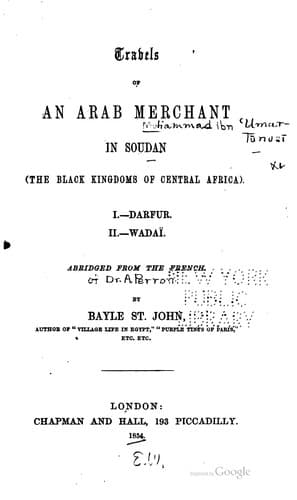
Travels of an Arab merchant in Soudan (the Black Kingdoms of Central Africa)Tūnisī, Muḥammad ibn ʻUmar
History
Travels of an Arab merchant in Soudan (the Black Kingdoms of Central Africa)
Tūnisī, Muḥammad ibn ʻUmar
Darfur (Sudan) -- Description and travel; Wadai (Sultanate) -- Description and travel
Each people has a certain traditional system of tactics, which
it clings to, and will not alter or improve in any way. The
Forians divide their army into five divisions,—the vanguard,
the rear-guard, the main body, and the right and left wings. The
vedettes and scouts are spread all around during the march. Every
great functionary has a military character. The flags or standards
are always placed in front of the Sultan, under the command of the
king and a body of chosen men. The Forian flags are either red
or white, and so are those of Wadaï, except that in the latter
country the red are more common. The Forian Sultan is preceded
by ten banners, and the Wadaïan by at least thirty, which are
never lowered unless the prince is killed or taken prisoner. No
Sultan must fly after a battle, so that in case of defeat he must
be killed or taken prisoner. As long as the fight lasts, the drums
do not cease a moment to beat.
On the eve of a battle, each party chooses some sign by which the
soldiers are to be distinguished; as, for example, a band of bark
round the right wrist. In the absence of this precaution, as soon
as the _mêlée_ begins, it would be impossible to know friends from
enemies, for there are no uniforms and no distinctions of colour.
When the Forian troops charge an enemy they display great
animation. The horsemen brandish their swords, and each chief of a
Kardous, or squadron, sets up a song, to which his men reply. At the
time of the revolt of Mohammed Kourra I heard an Emin sing these
words:—“O-nas dio-ba-in,” which means, “The word which
you have in you;” and the soldiers replied, Kel-boa—“Come,
say it.” Then the chief went on, “O-nas dio-Keih,” and the
soldiers answered, Kel-boa ye kel-boa—“Come, say it: ha! ha! say
it.” In this way they worked up their courage, and each seemed
to become an inexpugnable tower.
Public-domain text, read in full here on John Shaqi.
Reviews
Reviews
No reviews yet
Be the first to share your thoughts on this work.
Elsewhere in the archive
Join the Discussion
Join the discussion
Sign in to leave a comment or review.
Sign InorCreate an account