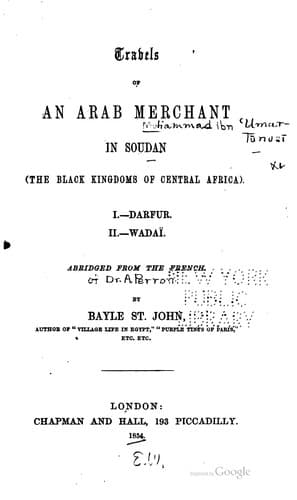
Travels of an Arab merchant in Soudan (the Black Kingdoms of Central Africa)Tūnisī, Muḥammad ibn ʻUmar
History
Travels of an Arab merchant in Soudan (the Black Kingdoms of Central Africa)
Tūnisī, Muḥammad ibn ʻUmar
Darfur (Sudan) -- Description and travel; Wadai (Sultanate) -- Description and travel
She did so; and at nightfall the stranger came, and they sat down,
and began to talk quietly together, he sitting with his leg over
that of the young girl. The Afrit soon came in, and saw them sitting
together. The girl wished to move away, but her new lover kept her
in her position, and continued the conversation. The Afrit then
exclaimed, “Who allowed thee to come here?” but obtained no
answer. He spoke twice more, and then, rushing forward, stabbed the
stranger through the thigh, until he reached that of the girl. She
tried to escape, but could not; and the Afrit, struck dumb by the
phlegm of his rival, who still did not move, drew forth his weapon,
and wished to escape. But he was now seized and cast to the ground,
and humiliated, and compelled to swear that he would never again
interfere with the girl, who was soon afterwards united in marriage
with her deliverer. Similar adventures are of frequent occurrence
in Wadaï.
A singular feature in the character of the Wadaïans is, that they
are jealous of a mistress, but take no care to interfere with
the conduct of their sisters or daughters. They even often seek
to bring admirers to their sisters, by praising their beauty and
physical qualities. And if any one is thus incited to come forward
as a suitor, the brother pleads for him, and is angry if he be
rejected. Sometimes the Wadaïans carry their complaisance so far,
that they take friends to their wives, and leave them with them. The
women themselves are licentiously inclined, and often have many
lovers. In fact, throughout all Soudan, love seems to be the great
occupation. It runs fiery through the veins of the blacks, as sap
runs through the veins of trees. No one thinks it a duty to conceal
the object of passion, except when danger may arise. Otherwise,
he goes about publishing the name of her he loves, and shouting it
in every ear. But let us now pause, for if we dwell too long upon
one subject we shall engender weariness.
CHAPTER IX.
Arms in Soudan — Tactics — Emulation on the Field — Materials
of Weapons — Archers — War-Song — Breeds of Horses —
Education — Food — Price of Horses — Story of a Tamahan —
Winged and Speaking Horses — Metempsychosis — Poets — Kings in
War — Slave-hunts, manner of — The Firman — Collecting Capital
— Recruits — Sultan of the Hunt — Sharing the Spoil — Other
Regulations — Grain-Nests — Treatment of Slaves — Mortality
— Justification of Slavery — Savage love of Country — Manners.
The people of Soudan do not, in general, possess muskets, or cannons,
or fortresses. In battle, their horsemen are armed with the javelin
and the sabre, and the footmen with the spear or the arrow. The
latter has a buckler to protect himself, and the former a helmet
or coat of mail, or a padded tunic. Horses are covered with thick
housing to protect them against injury.
Public-domain text, read in full here on John Shaqi.
Reviews
Reviews
No reviews yet
Be the first to share your thoughts on this work.
Elsewhere in the archive
Join the Discussion
Join the discussion
Sign in to leave a comment or review.
Sign InorCreate an account