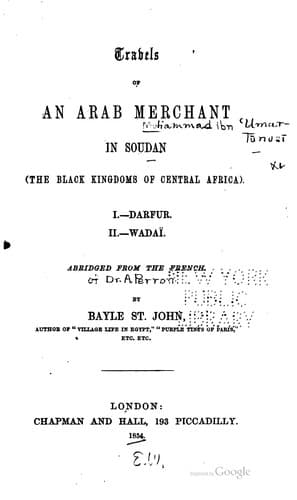
Travels of an Arab merchant in Soudan (the Black Kingdoms of Central Africa)Tūnisī, Muḥammad ibn ʻUmar
History
Travels of an Arab merchant in Soudan (the Black Kingdoms of Central Africa)
Tūnisī, Muḥammad ibn ʻUmar
Darfur (Sudan) -- Description and travel; Wadai (Sultanate) -- Description and travel
In some countries of Soudan there exist very singular ideas relative
to horses. Among others, it is said that a man had a magnificent
courser, of whom he was passionately fond, and visited night and
day. One night, however, he went softly, at an unaccustomed hour,
to see him, and beheld great wings spreading out from his side. The
man was petrified with fear, and the horse, suddenly closing up and
concealing his wings, said,—“The first time that thou comest,
without warning me of thy approach, thou shalt repent.” The people
of Darfur, in fact, are persuaded that the swiftness of horses arises
from their having real, but invisible, wings. They also believe that
these animals have a language of their own, and possess certain
human sentiments, as, for example, modesty. On certain occasions
they throw great veils over their stallions and their mares.
A Forian possessed a horse which had often saved his life by
his speed, and which he carefully tended. His wife died and he
married again. The new wife sometimes gave the horse its ration
mixed with dust, and left the litter untidy. The man, too, since
his new marriage, no longer attended on his beast with the same
care. One day he was in great danger and could not escape. He
was made prisoner with his horse and reduced to groom it. He now
carefully cleaned and attended on the animal, who one day said
to him,—“This is the recompense of the man who neglects his
horse.” The man was frightened and remained still, and the horse
went on,—“Fear nothing, there is no harm. Wilt thou promise me,
if I restore thee to liberty, always to have the same care of me
that thou hast now?” “I promise it.” “Well, then, unloose
me, mount, and fear not.” The Forian did as he was required,
and succeeded, in spite of a pursuit, in escaping.
The Temourkeh have fancies of a different kind. They believe that,
when one of them dies, after remaining three days in his tomb,
he is transported to another country, and marries a new wife. The
Massalit imagine that every one of them, after death, passes into
the body of some animal—of a hyæna, for example, or a cat.
To return to the subject of horses. Bays, with white feet and a
white star on the forehead, are often celebrated by poets, who
improvise verses for the sake of reward, in the presence of the
Sultan. They are generally nomadic Arabs; the blacks having little
poetical taste. Sometimes, under learned princes, there have been
Ulemas distinguished as poets. The Forians derive auguries from
certain motions of their horses. If they stretch the fore legs
abroad, victory is expected; but if the hind legs, defeat.
All these customs and ideas, which I have described as Forian,
may be applied almost exactly to Wadaï, especially those which
have reference to war. The Wadaïans, however, are less particular
in their military adornments, and do not sing in battle.
Public-domain text, read in full here on John Shaqi.
Reviews
Reviews
No reviews yet
Be the first to share your thoughts on this work.
Elsewhere in the archive
Join the Discussion
Join the discussion
Sign in to leave a comment or review.
Sign InorCreate an account