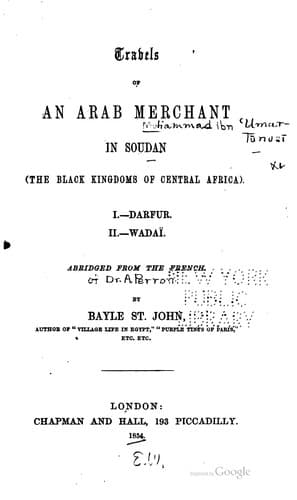
Travels of an Arab merchant in Soudan (the Black Kingdoms of Central Africa)Tūnisī, Muḥammad ibn ʻUmar
History
Travels of an Arab merchant in Soudan (the Black Kingdoms of Central Africa)
Tūnisī, Muḥammad ibn ʻUmar
Darfur (Sudan) -- Description and travel; Wadai (Sultanate) -- Description and travel
The Fertyt do not possess horses—oxen are the only domestic animals
they know. In most tribes the women act as beasts of burthen. When
in war, they place their king on a kind of ebony stool, borne by
relays of four men.
If they are defeated, they set his majesty down and leave him,
for no Sultan must fly. However, according to ancient custom,
no prince is killed in a _mêlée_, except by accident. If he be
taken prisoner, he is generally treated with respect. Kadis, Ulemas,
and musicians, are also spared, if taken, and set free. It is not
customary, however, if free women and children are taken, to sell
them as slaves, although Saboun did so, as an exemplary punishment,
when he took Bagirmeh.
The Ghazwah, or slave-hunts, in Dar-Fertyt, and amongst the
Jenakherah, are carried on in a different manner in Darfur and
Wadaï. In the latter country, the Sultan sends one of his governors
with a troop, chosen beforehand, to which no strangers attach
themselves; but in Darfur things are managed differently. There,
even a private individual, if he thinks himself capable of conducting
a Ghazwah, demands a salatieh, and, if he obtains it, sets out with
as many people as he can collect.
This is the way in which a complete Ghazia, or Ghazwah, is
managed. He who can make a present to the Sultan, and who has some
friend at court, goes to the Fasher in the first day of summer,
some time before the beginning of the rains. The best offering to
make to a Sultan is a horse ready bridled and saddled, with a slave
to lead him. If the prince accepts the present, and permits the
expedition, he gives to the solicitor a salatieh, that is to say,
a tall lance, and delivers a permission of excursion, conceived,
for example, in the following terms:—
“In the name of the Great Sultan, the refuge and the support of
all, the glory of the Arab kings and of the non-Arab kings, master
of the neck of all nations, sovereign of the two lands and the two
seas, servant of the two holy cities, putting his hope in the God of
justice and longanimity, the Sultan Mohammed Fadhl, the victorious,
to all those who these presents may see, emins, warriors, shartai,
damleg, and chiefs of our armies,
Public-domain text, read in full here on John Shaqi.
Reviews
Reviews
No reviews yet
Be the first to share your thoughts on this work.
Elsewhere in the archive
Join the Discussion
Join the discussion
Sign in to leave a comment or review.
Sign InorCreate an account