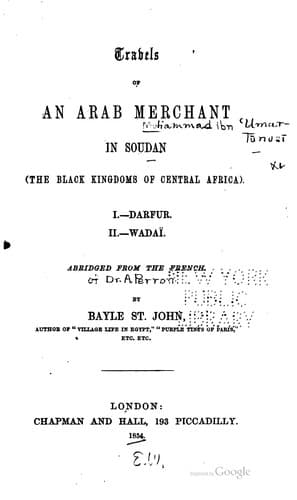
Travels of an Arab merchant in Soudan (the Black Kingdoms of Central Africa)Tūnisī, Muḥammad ibn ʻUmar
History
Travels of an Arab merchant in Soudan (the Black Kingdoms of Central Africa)
Tūnisī, Muḥammad ibn ʻUmar
Darfur (Sudan) -- Description and travel; Wadai (Sultanate) -- Description and travel
One of the duties of the officers of the sultan is to search out the
nests in which the Fertyt hide their grain; for, finding themselves
constantly attacked by their neighbours, these people conceal
their provisions in the trees so carefully, that an unaccustomed
traveller would never suspect their existence. They choose for this
purpose trees which are very leafy and tufty. They cut a certain
number of branches, with which they make a kind of large hurdle;
on this they spread, first, a bed of leaves, and then a bed of
millet-husks; then they build thereon a little conical hut, in
which they pile their grain, and, closing up the opening, leave it
until they require it for their use. The thickness of the leaves,
and the intricacy of the branches, entirely conceal these aërial
barns. The whole country is covered with monstrous trees growing
in forests, so that it is not easy to discover these stores.
The Fertyt who inhabit the highlands bury their grain in matmourah,
or deep pits, lined with millet leaves. The Forians also keep
their corn in matmourah, though the rich deposit their harvests in
vast sheds.
The men who obtain permission to go upon slave-hunts have their
itinerary marked down beforehand, and it is forbidden to overpass the
limits set. This is done to prevent different Ghazwah from meeting
and fighting one with the other. The Sultan sometimes delivers
sixty or seventy salatieh in the course of a year; but many of these
expeditions are not important in number. They sometimes consist of as
few as fifteen men. These hunts bring into the hands of the Forians
a considerable number of slaves. If they all arrived in Darfur, the
country would be overstocked; but many of them die of ill-treatment
during the journey, or are killed. If a slave, from fatigue or
other reasons, determines not to proceed, he sits down and says,
“Kongorongo,” that is to say, “Kill me.” He is instantly
killed with clubs in presence of his companions, in order to frighten
them, and deter them from imitating his example. Women are treated
in the same manner. Many of the prisoners die of fatigue by the way,
and others of diarrhœa, caused by change of food. Sometimes epidemic
diseases, such as dysentery, seize the whole flock, and nearly all
perish. Two or three out of twenty are often all that survive. On
arriving in Darfur many also perish from the effects of the climate,
though such as are treated with gentleness, and are submitted to
a proper regimen, generally survive. Acclimated slaves sell for a
much higher price than those who have been recently brought.
Public-domain text, read in full here on John Shaqi.
Reviews
Reviews
No reviews yet
Be the first to share your thoughts on this work.
Elsewhere in the archive
Join the Discussion
Join the discussion
Sign in to leave a comment or review.
Sign InorCreate an account