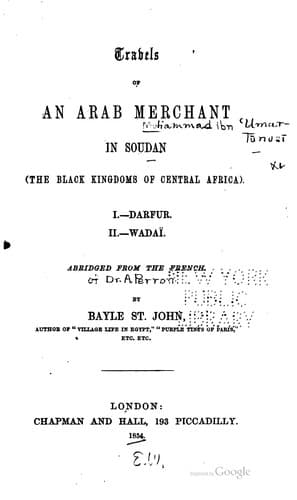
Travels of an Arab merchant in Soudan (the Black Kingdoms of Central Africa)Tūnisī, Muḥammad ibn ʻUmar
History
Travels of an Arab merchant in Soudan (the Black Kingdoms of Central Africa)
Tūnisī, Muḥammad ibn ʻUmar
Darfur (Sudan) -- Description and travel; Wadai (Sultanate) -- Description and travel
The sultan is entitled to every disputed slave, and to the property
of all who die, without direct heirs, on the road. He, however,
is obliged to take from his share the presents to be made to the
Sultan and to the great people who have assisted him in obtaining
his privilege.
The master of a salatieh, when the excursion has been fortunate,
easily acquits all expenses, pays his debts, makes the necessary
presents, and has a hundred slaves left for himself. Besides this,
the horses, the camels, the asses, and all the harness and baggage
brought back, remain as his property. He resumes possession of
everything he has distributed, except the garments. In fine, each
individual returns to his country with the booty which, by the
grace of God, he has been able to take.
The leader of a hunt always treats with consideration the people
who compose his court, and sometimes does not take from them any of
their share. On the other hand, it is they who watch over his safety,
and attend to him. At each halt they get ready a shelter for him,
and send people forward to prepare each station. For this purpose,
they bring with them from Darfur skins of animals, millet-stalks,
and poles sufficient to make every day an enclosure or dwelling for
the sultan. These materials are carried from camp to camp. In fine,
the whole ceremonial of this expedition resembles the march of a
real Sultan.
When the troops surround one of the stations of the Fertyt, and
the inhabitants yield without resistance, the sultan takes the
chief as a prisoner, treats him honourably, gives him a dress,
and afterwards liberates him; but he seizes on all the grown men,
the youths, the women, and girls, leaving only the old people and
those who do not seem to be in a state to undergo the fatigues of
a journey. The leader of a hunt may form or break alliances with
tribes who agree to become tributary to Darfur; but he is obliged
to act according to the rules of justice and equity. At any rate,
he is induced to behave well towards his subordinates, by the hope
of taking them along with him another year.
Public-domain text, read in full here on John Shaqi.
Reviews
Reviews
No reviews yet
Be the first to share your thoughts on this work.
Elsewhere in the archive
Join the Discussion
Join the discussion
Sign in to leave a comment or review.
Sign InorCreate an account