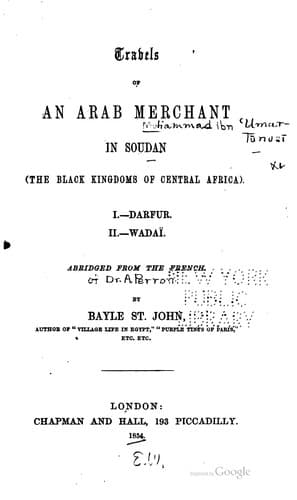
Travels of an Arab merchant in Soudan (the Black Kingdoms of Central Africa)Tūnisī, Muḥammad ibn ʻUmar
History
Travels of an Arab merchant in Soudan (the Black Kingdoms of Central Africa)
Tūnisī, Muḥammad ibn ʻUmar
Darfur (Sudan) -- Description and travel; Wadai (Sultanate) -- Description and travel
But the Prophet has also authorised the ransom of prisoners. “After
the fight,” he says, “you may give liberty to prisoners or
accept a ransom for them, in order to put a stop to the calamities
of war. As for those who obstinately repel my law, and reject
the religion of Islam, offer them the choice between war and the
obligation of an annual tribute, by which they may buy security
and life. If they take up arms against you, whoever is made captive
shall be sold.” Nevertheless, all men, as children of Adam, are
equal; the only difference being, that some have adopted the faith
of Islam, and others a different, that is, an erroneous faith.
The inhabitants of Muslim Soudan, in their excursions against the
idolaters, do not observe what is prescribed by the word of God, and
never call upon them before the attack to embrace Islamism. They rush
suddenly on the tribes of the Fertyt and Jenakherah, and, without
preliminaries, without appeal to faith, without pacific attempts
at proselytism, they assail, combat, take them as slaves, and sell
them. But the fact of capture once accomplished, these people,
being idolaters, it becomes lawful for Muslims to sell them. He
who has acquired possession of a slave, man or woman, is bound to
conduct himself towards him or her according to the principles of
justice and religion. He must not exact from his slaves too great an
amount of work. He must feed them with the food which he prepares
for himself and his family, and he must clothe them with care;
for a slave is likewise the creature of God.
Captives are treated in exactly the same manner in Darfur and Wadaï,
but there is a difference in the way in which slave-hunts are carried
on. In the former country, although the authority comes direct from
the Sultan, he has nothing to do with the details. But in Wadaï,
where there is greater respect for the sovereign power, a general is
chosen to perform a Ghazwah, and nearly the whole product goes into
the hands of the Sultan. The slaves taken on these occasions are
all equally without belief in God, without knowledge of a Prophet
or revelation, without religion or civil law. They adore blocks of
stone, and build chapels for these divinities, and make offerings to
them of lances and rods of iron. I had once a slave from Dar-Binah,
who, hearing mention of God, observed that his God was much greater
than ours. I asked him what he meant, and he said his God was so
large, holding his hands at a certain distance the one from the
other. I told him that there was only one God for all the world,
for all countries, and all climates; that he was great, powerful,
and invisible; and I repeated these words until my slave understood
them. The ignorance of these people, and their want of authoritative
traditions, render it easy to instil a new religion into them. I
have seen a young girl learn the Muslim profession of faith the
very day of her capture, and repeat it without emotion or surprise.
Public-domain text, read in full here on John Shaqi.
Reviews
Reviews
No reviews yet
Be the first to share your thoughts on this work.
Elsewhere in the archive
Join the Discussion
Join the discussion
Sign in to leave a comment or review.
Sign InorCreate an account