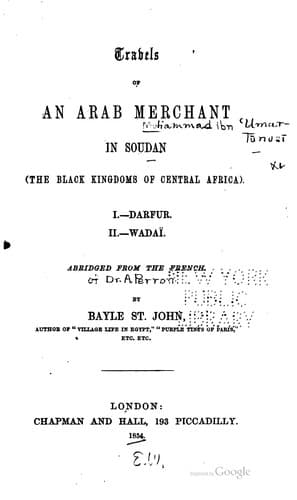
Travels of an Arab merchant in Soudan (the Black Kingdoms of Central Africa)Tūnisī, Muḥammad ibn ʻUmar
History
Travels of an Arab merchant in Soudan (the Black Kingdoms of Central Africa)
Tūnisī, Muḥammad ibn ʻUmar
Darfur (Sudan) -- Description and travel; Wadai (Sultanate) -- Description and travel
These people are wonderfully ignorant, and only learn that there
are other men on the face of the earth besides themselves by the
periodical appearance of the Ghazwah. They have many singular
customs; among others, they are very particular in preventing
marriage within certain degrees of consanguinity. This is more
remarkable, because both sexes constantly mix together nearly
entirely naked. Women and men wear only a little apron, or cover
themselves with leaves. By what inspiration have they been able to
establish and preserve more rigid restrictions than Muslims?
All these people lead a poor and miserable life; yet they
passionately love their country, and cling to the place which has
given them birth. If they leave their villages and their huts, or
are taken away into slavery, their thoughts and their desires carry
them constantly back to their country. In their childlike simplicity
they often fly away from their masters, to endeavour to return
to their miserable dwelling-places; and, when they are pursued,
they are always found toiling back on the direct road. They are so
simple-minded, that although every year their country is ravaged
by slave-hunts, those that escape always return to the old spot and
reconstruct their villages, and wait until they are again disturbed.
I have already said that they take one precaution, namely, to
hide their store of grain in the trees. Some also build their
dwelling-places there, cutting out a space amidst the branches,
and constructing a conical hut, well secured against the rain. To
this nest the Fertyt and his wife climb up by means of the nobs
and projections of the trunk. Sometimes a single tree bears the
grain-store and the hut; but they are generally separate.
These savages have wonderful skill in certain arts. The shafts of
their javelins and lances are admirably polished; and the ebony
stools they make would do credit to the workshops of the most
civilised nations. But, when we consider their miserable existence,
and how they are deprived of all that contributes to the enjoyment
of life, such as agreeable food and proper garments, we must class
them among the lowest savages. Glory be to the Eternal, who has
distributed societies in various forms, according to his pleasure!
CHAPTER X.
Stay in Darfur — Sheikh desires to depart — Presents of Saboun
— Inspectors — A Fair in the Desert — A Guide — A Blood-feud
— The Well of Daum — Hostile Tribe — A Flag of Truce —
Attack — An Interview — A Camel for a Camel — A Murder —
Harassing March — The Tibboo-Reshad — An Odd Sultan — Fresh
Persecution — Hungry Majesties — Loss of Three Slaves and an
Ass — The Sheikh in Love — Departure — Tibboo Camels —
Killing the Devil — Character — Thirst of the Desert.
Public-domain text, read in full here on John Shaqi.
Reviews
Reviews
No reviews yet
Be the first to share your thoughts on this work.
Elsewhere in the archive
Join the Discussion
Join the discussion
Sign in to leave a comment or review.
Sign InorCreate an account