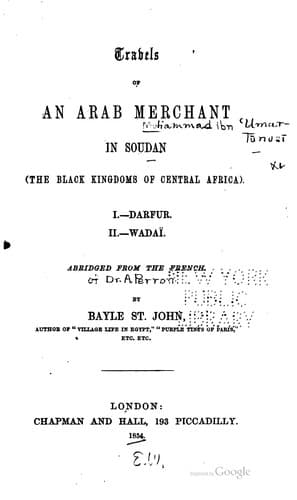
Travels of an Arab merchant in Soudan (the Black Kingdoms of Central Africa)Tūnisī, Muḥammad ibn ʻUmar
History
Travels of an Arab merchant in Soudan (the Black Kingdoms of Central Africa)
Tūnisī, Muḥammad ibn ʻUmar
Darfur (Sudan) -- Description and travel; Wadai (Sultanate) -- Description and travel
When he started with us he had with him more than a hundred and
thirty persons, all relatives. The rest of the caravan was composed
of fifteen Wadaïans and five Arabs, myself, a man of Tripoli, named
the Reis Abdallah; a Fezzani, Mohammed Khayr Yasir; another Fezzani,
the Seid Ahmed, from the village of Zouylah; and one named Khalyl,
of Tripoli. In proceeding towards the well of Daum we lost our way
in the desert, and fearing, if we moved on, that we should only lose
time, we halted, made our camels kneel, and buried our water-skins,
as deep as possible, beneath the baggage, to preserve them from
the heat of the sun. Our caravan started, Ahmed took with him a
certain number of his cousins, and searched through the desert to
the right and to the left, seeking for the well which we ought by
this time to have reached. They remained a long time absent, and
the day was far advanced when they returned. Their faces were grey
with dust; but they brought joyful tidings, namely, that the well
was near at hand. So we urged on our camels, and at last beheld the
daum-trees in the distance. Every one began to cry out, “There
they are! there they are! Those are the trees under which we are
to rest this day!” We had scarcely uttered these words, when we
beheld in front of us a troop of the Tibboos, called Turkman-Tibboos,
and felt alarm. They rarely come to meet caravans, for they station
towards Libya, divided into peoples of varying numbers, each with
a Sultan, or king. The tribe that had met us had its principal
station at a place called Marmar. They had known, for two or three
months, by means of a traveller from Wadaï, that the master of
our caravan was to be Ahmed, against whom they had a blood-feud;
and it was for this reason that they waylaid us on our journey.
They stood right in our path, and sent forward a man on a camel,
who galloped rapidly towards us, as swift as a horse. It is
marvellous to see how skilfully these Tibboo tribes manage their
dromedaries, or riding-camels. They train and exercise them like
horses, to numerous delicate manœuvres, and have no other rein
but the _zimâm_, or light cord, which by one end is tied to a
hole pierced in the moving edge of the animal’s nostril. Nearly
all these marauding Tibboos are clothed in sheep-skins with the
wool on. He who advanced towards us had the litham over his face;
that is to say, part of the stuff of his turban was wrapped three
or four times round his head and visage, so that the eyes only
were to be seen. When he was near to us he cried out, in his own
language,—“Ho! people of the caravan, the Sultan is coming with
his soldiers to the well. He forbids you to approach it. Know that
you shall only do so when you have given up your guide to be killed,
in expiation of the murder of one of our brothers. What are your
intentions? Tell me, that I may inform the Sultan.”
Public-domain text, read in full here on John Shaqi.
Reviews
Reviews
No reviews yet
Be the first to share your thoughts on this work.
Elsewhere in the archive
Join the Discussion
Join the discussion
Sign in to leave a comment or review.
Sign InorCreate an account