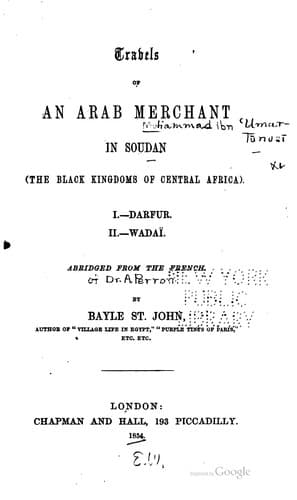
Travels of an Arab merchant in Soudan (the Black Kingdoms of Central Africa)Tūnisī, Muḥammad ibn ʻUmar
History
Travels of an Arab merchant in Soudan (the Black Kingdoms of Central Africa)
Tūnisī, Muḥammad ibn ʻUmar
Darfur (Sudan) -- Description and travel; Wadai (Sultanate) -- Description and travel
One of the Tibboos of our caravan translated what the messenger said,
and we all decided at once that we would not deliver up Ahmed to his
enemies, and that if the Tibboos asked only for a rope’s end they
should not have it. “Retrace thy steps,” said we to the envoy,
“and tell thy master that we have nothing to do with him—that
we have no one to give up. Go!”
The messenger galloped swiftly away to report our answer, and the
Sultan prepared to attack us. Then the Tibboos, who formed part of
our caravan, separated from us, and, with the exception of Ahmed
and his family, went off to some distance. Our party, counting
Ahmed, only contained twenty-five individuals,[57] not counting
the slaves, who were in great numbers. As we approached the well,
the Tibboos advanced in a mass, all mounted two-and-two on about
sixty or seventy camels. They rushed towards us, furiously casting
their javelins. We, that is to say the five Arabs, waited for their
approach, and fired a volley at them. Surprised, they turned back
and fled like beaten wolves. We remained masters of the well, and
encamped there. We drank, and allowed our camels to pasture on the
wild herbage of the neighbourhood.
We thought that these savage Tibboos, whom we had so easily put
to flight, had returned to their dwelling-places, and we rested
at our well for two whole days; but, on the third, we suddenly
heard loud cries and frightful imprecations. We sent to see what
was the matter, and saw four camels resting near a body of armed
people. Near them was our guide Ahmed, who stood amidst his people
and the Wadaïans of our caravan. With the armed strangers was an
old man, who seemed to be their chief. He had a piece of carpet
tissue rolled round his head, four or six fingers in breadth, and
about a cubit long. This old man was crouching down, like a dog or
a hyæna, on his heels. The chief of the Wadaïans said to him,—
“Wherefore dost thou return? Thou hadst departed. What dost thou
want? What dost thou expect?”
“Know,” was the reply, “that I am the Sultan of these deserts;
and that I have as many soldiers as you can count. What do I want? I
come to advise you to deliver up Ahmed, if you wish to depart without
blows or wounds. I know that you and I are not at war, but if you
refuse my request there will be danger. That Ahmed slew my cousin,
whom I loved as if he had been the son of my mother. It is my duty
to avenge my cousin, and cleanse myself from the shame of leaving
that murder unpunished.”
“But,” said the Wadaïan chief, “art thou not afraid of being
killed as thy cousin was killed?”
“I have no fear. He who kills me will be killed in his turn. We
never forget this duty—never abandon the vengeance of blood,
though we should be hacked to pieces with a knife.”
Public-domain text, read in full here on John Shaqi.
Reviews
Reviews
No reviews yet
Be the first to share your thoughts on this work.
Elsewhere in the archive
Join the Discussion
Join the discussion
Sign in to leave a comment or review.
Sign InorCreate an account