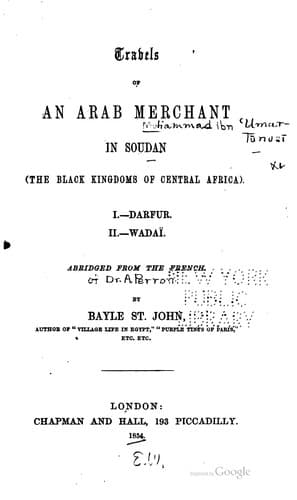
Travels of an Arab merchant in Soudan (the Black Kingdoms of Central Africa)Tūnisī, Muḥammad ibn ʻUmar
History
Travels of an Arab merchant in Soudan (the Black Kingdoms of Central Africa)
Tūnisī, Muḥammad ibn ʻUmar
Darfur (Sudan) -- Description and travel; Wadai (Sultanate) -- Description and travel
Having remained three days at Catroun, we went in four more to
Mourzouk, usually called Zeylah. At the gates our slaves were counted
and registered by the officers of the customs, as if we had been
entering a great city. But Mourzouk is a wretched borough, inhabited
by blacks from Afnou, and a heterogeneous population of Arabs
from Tripoli, Jalou, Aujila, and Derna. It is situated in a plain,
far from any other town or village. The bazaar is miserably small,
containing only fourteen shops. A market is held every afternoon
for about an hour and a half; and goods are then sold by a crier,
who goes up and down, announcing the prices offered.
We were presented to the Sultan, as he calls himself, although he
is in reality a mere governor. He was the well-known Mountaser,
who afterwards rebelled against the Pasha of Tripoli. He received us
with much haughtiness, and with an attempt at state. I never saw such
an enormous white turban as the one he wore. It was folded in the
Mekka fashion,—that is, swelling more over the right temple than
the left,—but the size was so ridiculously exaggerated, that his
Majesty dared scarcely bend his head. I could not help laughing to
myself at his airs of importance. He deigned to receive our presents,
but addressed us not except by slight signs. Decorum in Fezzan
consists in restraining the prodigality of ceremonies. The court of
this mighty Sultan consisted of a number of fellows wrapped in old,
worn-out blankets. They looked very wretched. I afterwards went to
the Vizier Othman’s, and found him surrounded by a lot of dirty
people playing on old tambourines and cracked flutes. Everything in
this country is miserable. I could find no food to eat with pleasure,
and spent three months there very wretchedly.[59]
Few strangers from the Magreb, or any other country, who are at
all accustomed to easy living, can make up their minds to settle
at Mourzouk. They say that a learned man, an Ulema, once came to
teach at that city. He was immediately surrounded by disciples; the
crowd came to his lessons; he was listened to with avidity—which
is the supreme happiness of men of science: yet, in spite of
this, one morning the worthy Ulema ran away from the place in
a great hurry. He could not put up with it any longer. “It is
impossible to stand it,” said he. “Wherefore?” inquired some
one.—“Wherefore? Why, because it is the veritable image of
hell. Hell is hot,—so is Mourzouk: the damned are black,—so are
the people of Mourzouk: hell has seven gates,—so has Mourzouk. What
the deuce do you expect one to do in a place which completely answers
the definition of hell?” So away he went as fast as he could.
Public-domain text, read in full here on John Shaqi.
Reviews
Reviews
No reviews yet
Be the first to share your thoughts on this work.
Elsewhere in the archive
Join the Discussion
Join the discussion
Sign in to leave a comment or review.
Sign InorCreate an account