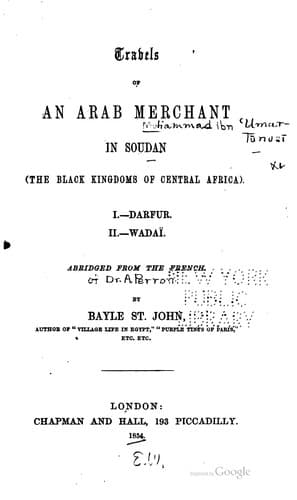
Travels of an Arab merchant in Soudan (the Black Kingdoms of Central Africa)Tūnisī, Muḥammad ibn ʻUmar
History
Travels of an Arab merchant in Soudan (the Black Kingdoms of Central Africa)
Tūnisī, Muḥammad ibn ʻUmar
Darfur (Sudan) -- Description and travel; Wadai (Sultanate) -- Description and travel
Verily, it is an abominable country. Women sell themselves for a
handful of barley,—at least so they say. Besides, there is not a
dish which can be eaten with pleasure; there never falls a drop of
rain; man and beasts live on the same food— dates: there is the
abiding-place of fever, nourished by continual feeding on dates and
barley-bread. Wheat is so rare that only the great people and the
Sultan can indulge in it: butter is as difficult to be got as red
sulphur. What can one do with the grease which is sold at Mourzouk
for kitchen-stuff? What _can_ one do in a country where men eat
clover, with a little salt, as a delicacy, where a fowl costs half
a mitkal of gold, and ten eggs are charged half a riyal? I have
seen servants come before the Women’s Kadi to complain that they
had not enough to eat,—even of dates. In one word, merchants only
have any cause to be pleased with Mourzouk; for they gain sometimes
a thousand per cent there.
It is by the passage of the caravans that the city subsists. All
those that come from Bornou, from Wadaï, from Bagirmeh, and, indeed,
both Western and Eastern Soudan, meet here. Merchants of Aujila ply
between Egypt and Mourzouk; and those of Sokneh and Bengazi between
Tripoli and Mourzouk, which has become a veritable central mart
of commerce. The slaves preferred there are those of Haussa, the
capital of Afnou; and, indeed, in all markets they fetch the highest
prices. The Tuaricks and the Tuatee come for the purposes of trade
to Mourzouk, where also pass the pilgrim caravans from all the West.
The people of Fezzan are remarkable for benevolence and probity,
as an example will prove. A Fezzanee had dissipated his moderate
fortune in extravagance, and was reduced to misery. Some days
before the departure of a caravan for Soudan, accordingly, he went
and cut a number of palm-leaves, and, taking the stems, wrapped
them up carefully in thick cloth, making them appear like bales of
merchandise. Then he placed them on a camel, and taking them into
the city, paid a couple of douros on each as a tax; for it is the
custom to make a fixed charge, and not to search. Having got his
two bales safe in his house, the Fezzanee went to the Vizier Othman,
and said,—“To-morrow a caravan departs for Soudan. I have just
received two bales of merchandise, which I cannot take with me;
I will leave them with thee as a pledge, if thou wilt lend me two
hundred dollars for the speculation I am going to undertake. When
I return I will pay.” “Willingly,” said the vizier, trusting
in his good faith. The bales were brought, the money was counted
out, and the man departed. In six months he returned, having been
fortunate, and went to the vizier, confessed his trick, paid back
the money, and the two were ever afterwards friends. The Prophet
has said,—“Good faith is the ark of salvation.”
Public-domain text, read in full here on John Shaqi.
Reviews
Reviews
No reviews yet
Be the first to share your thoughts on this work.
Elsewhere in the archive
Join the Discussion
Join the discussion
Sign in to leave a comment or review.
Sign InorCreate an account