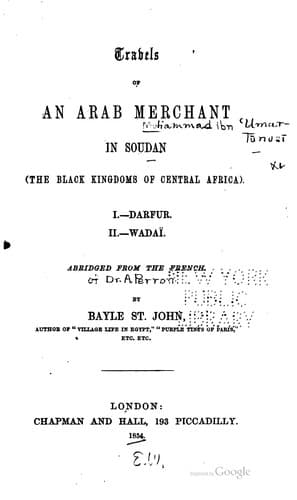
Travels of an Arab merchant in Soudan (the Black Kingdoms of Central Africa)Tūnisī, Muḥammad ibn ʻUmar
History
Travels of an Arab merchant in Soudan (the Black Kingdoms of Central Africa)
Tūnisī, Muḥammad ibn ʻUmar
Darfur (Sudan) -- Description and travel; Wadai (Sultanate) -- Description and travel
[Footnote 43: The French traveller, Le Vaillant, gives, I remember,
some still more curious facts of this nature. Among the tribes which
he visited, advancing towards Central Africa from the south, he saw
bulls which seemed, at first sight, to have four or even eight horns.
He afterwards learned that the owners, as soon as the horns began to
grow, used to split them carefully into two or four parts, and
afterwards carefully bend and twist them into the shapes they desired.]
[Footnote 44: Assertions of this kind, so common among travellers,
have generally been disproved by more careful research.]
[Footnote 45: In fact, they appear to mean only a single country, the
capital of which is Kanou.]
[Footnote 46: News travels quicker than we are apt to think amongst
the Easterns, especially if it concerns their faith. Probably Zaky was
excited to begin his crusade by the news that came from Arabia.]
[Footnote 47: Niffy is situated on the easternmost bend of the Niger.
It appears certain that the American slave-traders penetrate sometimes
thus far with their schooners. Mr. Richardson heard, on the confines
of Soudan, a very detailed account of white men who came up the great
river to Niffy.]
[Footnote 48: “This,” says Mr. Perron, “refers probably to the
foundation of Sakkatou, which name, however, was not given till 1805.”]
[Footnote 49: These bags are used to carry water. Two of them form a
camel-load. The water-dealers fill from them the sheep-skin bags which
they carry on their backs.]
[Footnote 50: It would be difficult to invent any more effective way
of exciting a feeling of horror against this wretched institution of
slavery, which still lags in the rear of the army of abuses that has
been put to flight, than this cold-blooded statement.]
[Footnote 51: See “Voyage to Darfur.”]
[Footnote 52: The Sheikh here relents from his uncompromising
condemnation of the Forian character, which probably had its origin in
the rough treatment he himself received on some occasions.]
[Footnote 53: It is worth while to reflect on the frightful state of
society that must be produced by a consistent adherence to the laws of
the Koran, which it is the fashion among sensualists in all times, and
politicians at this particular moment, to praise directly, or by
implication.]
[Footnote 54: There is something very ludicrous in this excessive
severity against women expressed by a man like the Sheikh. The same
one-sided feeling, in a mitigated form, dictated a clause in the
proposed divorce bill of this last session.]
[Footnote 55: I have myself noticed the rapidity with which a Bedawin
encampment prepares to meet what may seem to be a surprise. When our
caravan rose over the little hills that command the settlement of
Mudar, scarcely a minute elapsed before the women were engaged in
driving away the cattle on the opposite side, whilst the men came
running to meet us, imagining us to be an attacking party.]
Public-domain text, read in full here on John Shaqi.
Reviews
Reviews
No reviews yet
Be the first to share your thoughts on this work.
Elsewhere in the archive
Join the Discussion
Join the discussion
Sign in to leave a comment or review.
Sign InorCreate an account