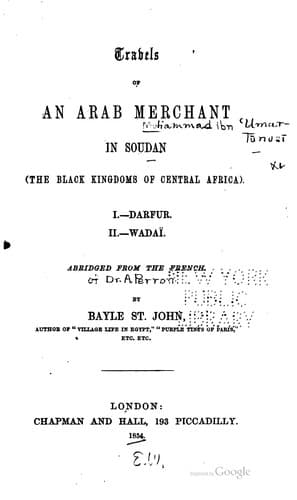
Travels of an Arab merchant in Soudan (the Black Kingdoms of Central Africa)Tūnisī, Muḥammad ibn ʻUmar
History
Travels of an Arab merchant in Soudan (the Black Kingdoms of Central Africa)
Tūnisī, Muḥammad ibn ʻUmar
Darfur (Sudan) -- Description and travel; Wadai (Sultanate) -- Description and travel
[Footnote 35: It is just possible that Saboun may have been ruthless
only against his political enemies. The glowing character, however,
which I have given complete in the text, is evidently the work of a
parasite. The Sheikh has as little respect for human life as a Soudan
prince. In a lengthy episode, which I am obliged to omit, he refers to
Saboun’s murder of his brother, and says that a man who gets his
enemies into his power, and pardons them, prepares for himself dangers
which may cost him his life, “for according to the Prophet, on whom be
the benediction of God, no wise man suffers himself to be twice stung
by a viper;” and then he goes on to tell an illustrative story of
Noman the One-eyed.]
[Footnote 36: Let us here admire the Sheikh’s modesty—a quality not
common in travellers. An European doctor, after a week or two’s
residence in a country of which he does not know the language, will
send home to a learned society an elaborate account, not only of the
present state, but of the history and origins of all its tribes and
families. The Sheikh resided more than a year in Wadaï, and nearly
eight years in the neighbouring country of Darfur.]
[Footnote 37: This is the punishment prescribed by the Muslim law. In
most countries, however, the same feeling which forces women to use
the veil leads to the employment of the sack for women taken in
adultery.]
[Footnote 38: These observations may be transferred from the Bornouese
to the classes which check public opinion at present in France, and,
to a certain extent, in England. I notice that most people who are
opposed to war on principle—setting aside those who are guided by
religious motives, the smallest number—are comfortable and fat.]
[Footnote 39: In a former Chapter it is said that the palace has seven
gates, the fourth of which is the iron gate.]
[Footnote 40: This state ought scarcely to be reckoned amongst those
of Soudan. It more properly belongs to the Sahara, although the
neighbourhood of Soudan has certainly influenced its manners and its
population. It is inhabited by people of Berber origin, mixed with
blacks.]
[Footnote 41: The Sheikh speaks loosely and from report. The route
from Bornou to Adagez (Aghadez) is first slightly north of west, as
far as Zindar, and then turns north-north-west. Adagez is the capital
of the kingdom of Aheir, the northern limits of which form, in fact,
the southern limits of the Central Sahara.]
[Footnote 42: The Sheikh seems distressed lest the Jengueh should
stifle themselves; but it is evident that, after having anointed their
bodies, they simply roll in the ashes, and collect, as it were, in
this way a peculiar kind of counterpane.]
Public-domain text, read in full here on John Shaqi.
Reviews
Reviews
No reviews yet
Be the first to share your thoughts on this work.
Elsewhere in the archive
Join the Discussion
Join the discussion
Sign in to leave a comment or review.
Sign InorCreate an account