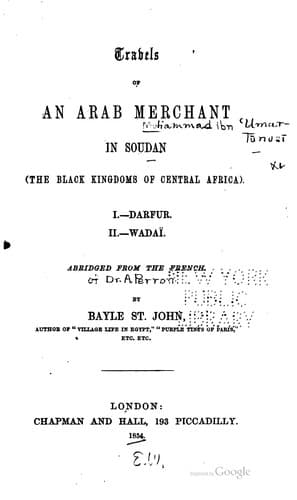
Travels of an Arab merchant in Soudan (the Black Kingdoms of Central Africa)Tūnisī, Muḥammad ibn ʻUmar
History
Travels of an Arab merchant in Soudan (the Black Kingdoms of Central Africa)
Tūnisī, Muḥammad ibn ʻUmar
Darfur (Sudan) -- Description and travel; Wadai (Sultanate) -- Description and travel
I shall say a few words of the origin of this expedition. In former
days there was a Sultan, named Saloun, who divided with his brother
the country which they had inherited—Saloun taking Darfur, and
his brother Kordofal, which had formerly been united under one
government. They swore never to undertake any intrigue one against
the other, and they and their descendants remained in peace for
nearly two centuries, until the time of Sultan Tyrab. Sultan Hashim,
prince of Kordofal, then collected a great army, and being of an
ambitious disposition, determined, it is said, to conquer Darfur. He
began by sending marauding parties to the frontiers, and when his
cousin wrote to him, begging to cease his molestations, answered
insolently. Tyrab, therefore, resolved to make war, or, at least,
chose this as a pretext. The real reason, however, was, that he had
formed a plan for breaking through the law of succession laid down by
Ahmed Bekr at his death. He wished to leave his throne to Izhak, the
Kaliph, and resolved to send the sons and grandsons of Ahmed Bekr,
and of the great people, into battle, that they might be killed, and
so that there should be nobody to oppose his designs. His secret,
however, was discovered, and, indeed, his whole plan subsequently
failed, by the death of his son, Izhak, who was killed in battle,
as will be seen.
At the news of the approach of Tyrab, Hashim fled away with his
suite and family, and took refuge in Sennaar, so that Kordofal was
conquered with ease. The Sultan ransacked the country, and reduced
the people to silence, and remained there until the next year, when
his troops and his followers loudly demanded to be allowed to return
to Darfur. He, however, pretended that Hashim was about to return,
and that it was necessary to remain to resist him. Soon, however,
the disgust of the army increased, and secret councils began to be
held. At one of these, the Vizier, Ali Wad Bargou, whose daughter
Tyrab had married, said boldly,—“What will you give me if I
kill the Sultan? I will get rid of him, and you shall put in his
place whom you please.” Those whose children Tyrab had taken out
to expose them to the danger of being killed promised him great
wealth if he succeeded, and it was agreed that the roll of a drum
should give the signal of assistance.
Public-domain text, read in full here on John Shaqi.
Reviews
Reviews
No reviews yet
Be the first to share your thoughts on this work.
Join the Discussion
Join the discussion
Sign in to leave a comment or review.
Sign InorCreate an account