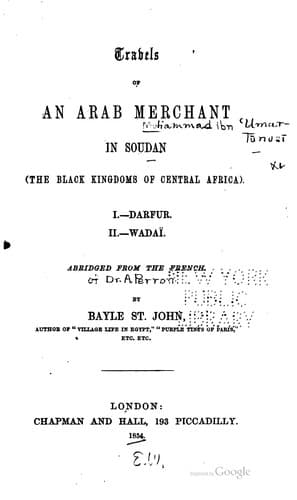
Travels of an Arab merchant in Soudan (the Black Kingdoms of Central Africa)Tūnisī, Muḥammad ibn ʻUmar
History
Travels of an Arab merchant in Soudan (the Black Kingdoms of Central Africa)
Tūnisī, Muḥammad ibn ʻUmar
Darfur (Sudan) -- Description and travel; Wadai (Sultanate) -- Description and travel
“No! It is thou who shouldst come to me.”
Then Adam advanced towards her, and this was the origin of the
custom, that the man should seek the woman. When he had sat down by
her side, and touched her with his hands, emotion thrilled through
his frame, and he became bewildered; but Eve said: “Stay, Adam:
Eve is only legitimately given to thee as a wife, on condition of
a dowry, and a common consent expressed.” Then God, in His Old
Language, pronounced a formula of marriage, and said:—“There is
nothing sublime but my grandeur; nothing imposing but my majesty;
and all creatures revere and adore me. I take you to witness—you,
my angels, and you, the inhabitants of my heaven—that I unite
in marriage this marvel of my creation, Eve, to this first man,
my image upon the earth; but on condition of a dowry—and this
dowry shall be, that he pronounce these words: ‘God is great;
there is no god but God.’” Thus were established and consecrated
the form and conditions of marriage for the posterity of Adam.
Every nation, however, has since modified the original custom,
and the Forians also have their special forms. Among them the
children—boys and girls—are generally mixed together. From a
very early age they are employed in watching the herds, and are
thus in constant communication. Many of them begin their intimacy
at that time, and become linked in an affection which time cannot
break. Love follows, and then the cares of love and jealousy; and
at last the lover, egotistical in his passions, wishes to keep all
the men away from his mistress. So he demands her in marriage, and
the contract of union is drawn up in presence of witnesses, and the
price of the bride, or the dowry, as it is called, is discussed. For
some time afterwards the ceremony is deferred; but at length the day
is fixed, and preparations are made for the nuptial feast. Animals
are slaughtered, drinks are prepared, and invitations are sent out.
Many music-women are hired to enliven the festival. Each of them
carries under her left arm three tambourines, on which she plays,
greeting every new troop of guests with a song in their praise. For
example,—“You, who brandish the shafts of your spears, may death
be slow to overtake you!—May the eye which looks enviously on you
become blind!—you, who brandish the steel of your lances,” &c.
I was once at a marriage festival where the women greeted me with
these verses,—“The Shereef comes from the mosque with a book
in one hand, and a sabre in the other; he bears away the Birguids
into slavery!”
Public-domain text, read in full here on John Shaqi.
Reviews
Reviews
No reviews yet
Be the first to share your thoughts on this work.
Elsewhere in the archive
Join the Discussion
Join the discussion
Sign in to leave a comment or review.
Sign InorCreate an account