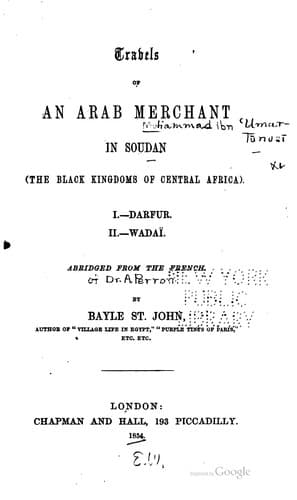
Travels of an Arab merchant in Soudan (the Black Kingdoms of Central Africa)Tūnisī, Muḥammad ibn ʻUmar
History
Travels of an Arab merchant in Soudan (the Black Kingdoms of Central Africa)
Tūnisī, Muḥammad ibn ʻUmar
Darfur (Sudan) -- Description and travel; Wadai (Sultanate) -- Description and travel
Those who give the festival meet the guests as they arrive, and sit
them down in groups. Food is immediately brought them according
to their dignity. Some, for example, are given boiled meats and
roast meats; others, cakes, and the red wine called Bulbul—The
Mother of the Nightingale. When all have eaten, they remain
sitting in the shade until the heat of the day has diminished,
and the shadows are beginning to lengthen. Then the young girls,
in their richest costume, leave the company of the women; and
the youth also, dressed out in their best, run to meet them, and
they prepare to dance. The girls range themselves in long lines,
in front of which lines of equal length are formed by the youths;
and the women, to the measured sound of the tambourines, fill the
air with their songs. At this signal, all the lines of young girls
begin to move and to advance with a slow, deliberate step, shrugging
their shoulders in various ways, and crouching down with strange
contortions and inflections of their bodies. Thus they reach by
degrees the line of youths, which remains motionless opposite, until
each comes face to face with her partner, when she begins to shake
her head rapidly, and fan and brush his cheeks with her tresses,
which have been carefully perfumed beforehand. Then the youths,
excited by these blandishments, brandish their lances, and raise
them horizontally over the heads of the girls, who begin to retire,
still dancing, and are pursued by their partners until they reach
the place whence they started. Here the young girls pass between the
young men and go dancing back alone. If there happens to be among
the spectators any young man whom a young girl wishes to lure into
the dance, she singles him out, and goes gently dancing towards him,
and waves her hair in his face. Upon this he shouts with joy, and
brandishes his lance and follows her. This attention on her part
imposes on him the necessity of giving her a banquet.
When the two lines have thus changed places, they begin to move at
the same time, and meet in the middle, where the girls cast the
whole of their hair upon the breast of their partners, who begin
to _rakrak_, that is to say, to utter peculiar cries of joy. The
whole company is now half-intoxicated, but the dance continues
until night-time, when the various groups separate and go to supper.
Public-domain text, read in full here on John Shaqi.
Reviews
Reviews
No reviews yet
Be the first to share your thoughts on this work.
Elsewhere in the archive
Join the Discussion
Join the discussion
Sign in to leave a comment or review.
Sign InorCreate an account