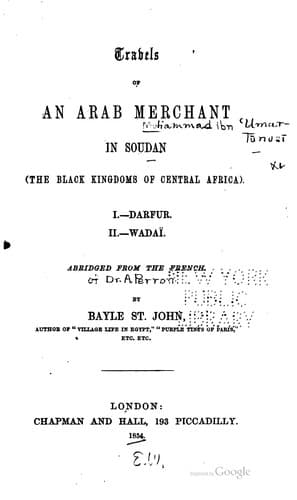
Travels of an Arab merchant in Soudan (the Black Kingdoms of Central Africa)Tūnisī, Muḥammad ibn ʻUmar
History
Travels of an Arab merchant in Soudan (the Black Kingdoms of Central Africa)
Tūnisī, Muḥammad ibn ʻUmar
Darfur (Sudan) -- Description and travel; Wadai (Sultanate) -- Description and travel
Besides this dance, which is called Delloukah, the Forians have
the Gyl, the Lengui, the Chekenderi, the Bendalah, and the Tonzy,
which is the dance of the slaves; but the dance peculiarly of
Forian origin, and which is special chiefly to the inhabitants
of the Marrah mountains, is the Tendina. Some of these dances are
peculiar to certain classes. The higher ranks dance the Delloukah;
the middle classes, the Gyl; and the inferior classes, the Lengui. In
the latter, the dancers utter peculiar cries, or rather grunts,
which resemble those emitted by workmen when chopping wood. In the
Chekenderi, a young man takes the waist of a young girl, who stands
before him with her back turned, in his hands. A young girl behind
him places her hands upon his hips; she is followed by a young man,
and thus a circle is formed. The dancers, leaning slightly forward,
move with very little steps; the girls gently shaking their anklets
in measure. This tranquil dance is accompanied by the songs of women
who are sitting by. The Bendalah is a dance, or rather a game,
peculiar to the slaves, in which they tie a string of large nuts
to their right foot, and kick at each other. The Tonzy resembles
the Chekenderi; and the Tendina is an exaggerated form of the latter.
Each kind of dance is accompanied by special songs. For example, in
the Gyl, the following is used:—“You banei, hei you banein! The
night is passing, oh, my Moutgal; my head is turning; the night is
going, oh, my Moutgal! yes, my head is turning!” The introductory
words have no meaning, and form an arbitrary chorus. One of the
singers sings the first and second lines, and then the others join
in with, “Ana rasy indur,”—my head is turning. They go on to
say: “The night is passing. Darfur (that is, the world, for the
world to them is a great Darfur) is full of sorrows. Come and rest
thy head upon my bosom.” The complete meaning of another song is
as follows:—“Oh thou, whom I love, thou bendest over me like
a flexible branch, and passion draws us away and makes us breathe
forth sighs! Thou lovest me, thou preferrest me to the daughters of
thy hamlet, and thereby thou shalt excite their jealousy against me,
and draw their vengeance upon me, for they will believe that thou
hast humbled them in my eyes! Oh thou, whose love recalls the perfume
of the sandal-wood, thou hast arisen like the odoriferous branches
of that tree, and thou leanest over our dwellings, to shade them
for ever; and happiness will always remain beneath thy branches!”
Public-domain text, read in full here on John Shaqi.
Reviews
Reviews
No reviews yet
Be the first to share your thoughts on this work.
Elsewhere in the archive
Join the Discussion
Join the discussion
Sign in to leave a comment or review.
Sign InorCreate an account