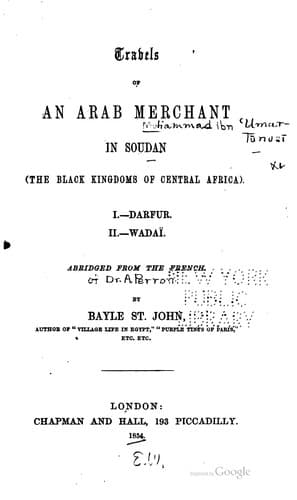
Travels of an Arab merchant in Soudan (the Black Kingdoms of Central Africa)Tūnisī, Muḥammad ibn ʻUmar
History
Travels of an Arab merchant in Soudan (the Black Kingdoms of Central Africa)
Tūnisī, Muḥammad ibn ʻUmar
Darfur (Sudan) -- Description and travel; Wadai (Sultanate) -- Description and travel
After the evening repast, the bride is promenaded, to the sound of
the Daloukah, all round the village, and then led to the nuptial
hut. Three or four hours after night-fall, the young men collect
together and take with them the bridegroom, and, with songs and
rakrakhas, conduct him to the hut. They remain without, whilst
the bride with her companions remains within. Then the bridegroom
nominates one of his friends as Vizier of the wedding, of which he
himself is the Sultan; whilst the bride within chooses a she-vizier,
under the title of Meirem. The latter is then entreated by the
young men to come out and speak to them, but she refuses for an
hour or two, and then issues forth, when the Vizier approaches her
and presents his compliments, and, in an amiable and polite manner,
begs her to allow the bride to present herself.
“Who are you?” then says the Meirem, “Whence do you come,
and of what bride do you speak?”
“We are strangers,” answers the Vizier; “we arrive from a
distant country, and will be delighted if the Queen would honour
us and cheer us with her presence.”
“The Queen is engaged,” then says the Meirem, “and cannot
appear; she has begged me to entertain all strangers and travellers
who may present themselves. What are your wishes?”
“We all know,” says the Vizier, “that thou art full of
graciousness and bounty, that thou art a perfect woman; but we have
a word or two to say to the Queen, and can say them to no other
than her.”
“Very good,” responds the Meirem; “but what will you give
to the Queen, and what will you give to me, if she presents
herself? For it is her custom to show herself only to those who
give her a present.”
“All that we possess, and even our life, we will give, if she
desires.”
This dialogue continues for some time, whilst the bride, concealed
behind a curtain, is listening, and the bridegroom also remains
silent. At length the Meirem consents to exhibit the Queen, and
raises the curtain, and she steps forth, upon which the Vizier
exclaims,—The Queen is for the King, but for us what remains?”
Then the Meirem calls forth the companions of the bride, and says,—
“My friends, I beg that you will treat these guests of our Queen,
this night, in a proper manner.” “Willingly,” they reply. Upon
which the Meirem, who knows who is engaged to whom, leads them forth
one by one and presents them to their lovers. Several couples, thus
brought together, pass the night conversing in the nuptial hut,
and the others go and sleep in the house of some friend.
Public-domain text, read in full here on John Shaqi.
Reviews
Reviews
No reviews yet
Be the first to share your thoughts on this work.
Elsewhere in the archive
Join the Discussion
Join the discussion
Sign in to leave a comment or review.
Sign InorCreate an account