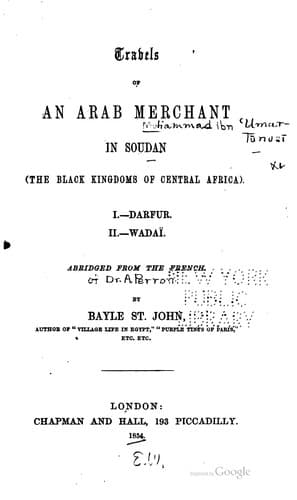
Travels of an Arab merchant in Soudan (the Black Kingdoms of Central Africa)Tūnisī, Muḥammad ibn ʻUmar
History
Travels of an Arab merchant in Soudan (the Black Kingdoms of Central Africa)
Tūnisī, Muḥammad ibn ʻUmar
Darfur (Sudan) -- Description and travel; Wadai (Sultanate) -- Description and travel
It is the belief among the Forians, that if the city takes fire,
the only means of arresting the progress of the flames is to bring
near them a woman, no longer young, who has never been guilty of
intrigue. If she be pure, by merely waving a mantle, she puts a
stop to the destruction. Success has sometimes rewarded a virtuous
woman. When I was in Darfur, a violent conflagration burst forth. The
Sultan and all his court came and endeavoured to stop it, but in
vain. Then a crier was sent about the city. He passed through every
street, exclaiming, “Is there any faithful woman here? Is there
a single faithful woman to be found?” But no one came forward,
and we must believe that none existed.
I must, however, mention, that conjugal virtues are far from being
so uncommon amongst the women of the wandering Arabs in Darfur and
its neighbourhood. These women, being more intelligent, are more
religious and more faithful than the Forians. Among them there is
far more propriety. An Arab woman, for example, who has a son in
an honourable position, will abstain from any love intrigue out of
respect for his name; but the Forian women not so. An intimate friend
of mine, whose name I will not mention, has related to me that the
mother of the Sultan Mohammed Fadhl, who was called Ambous,[19]
once married her brother to a slave-girl of hers. The wedding was
celebrated with great pomp, and an enormous crowd collected, of
which my friend was one. “I was standing,” he said, “looking
on, when the mother of the Sultan appeared, surrounded by a troop
of girls, elegant as gazelles. She was then thirty-five years old,
and her countenance was the most hideous possible to conceive. I
wondered why God had chosen so frightful a woman to be the mother of
a prince. Having led her brother to the nuptial hut, she came forth
jingling her anklets and her strings of beads, and, in the dark,
I felt a cloud of perfume surrounding me. She came towards me in
the midst of her slaves, and, seizing my hand, led me away. I dared
not resist, for fear of attracting attention. After proceeding a
little way, she whispered that she was tired—she who, before
she had been the mother of a Sultan, had been a hewer of wood
and a drawer of water, complained of a walk of a hundred yards! I
answered politely, and she led me into the hut and made me sit down,
and, after some coquetry, seeing that I would not understand, said
that she had a headache, and wanted me to repeat some verses of the
Koran. I did so, placing my hand upon her forehead, and the odour
of her perfumes troubled me; but suddenly I began to think of the
danger, and trembled. So the queen, with whom I had been left alone,
called out for one of her women, named Dera-el-Gader, who brought
me a dish, which I tasted, and found so good, that I ate heartily;
but suddenly we heard a great noise, and the servant came running,
saying,—‘The Sultan! the Sultan!’ Upon this the women took
Public-domain text, read in full here on John Shaqi.
Reviews
Reviews
No reviews yet
Be the first to share your thoughts on this work.
Elsewhere in the archive
Join the Discussion
Join the discussion
Sign in to leave a comment or review.
Sign InorCreate an account