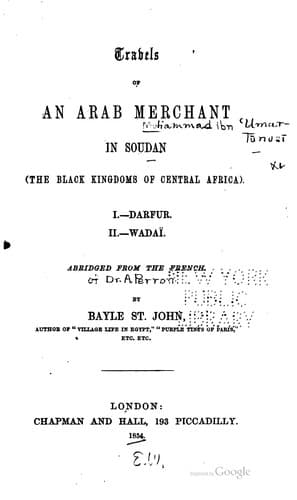
Travels of an Arab merchant in Soudan (the Black Kingdoms of Central Africa)Tūnisī, Muḥammad ibn ʻUmar
History
Travels of an Arab merchant in Soudan (the Black Kingdoms of Central Africa)
Tūnisī, Muḥammad ibn ʻUmar
Darfur (Sudan) -- Description and travel; Wadai (Sultanate) -- Description and travel
me and shoved me out, and I was enabled to hide, although some one
did cry out that a man was stealing away.” Such was the recital
of my friend, which proved to me that eunuchs are not sufficient
to prevent women from having lovers if they wish to do so.
I shall here add, that each tribe and nation of Soudan has women
celebrated for some qualities of beauty. The most beautiful women,
however, are those of Afnan; after them come the women of Bagirmeh,
of Bornou, and of Sennaar; then come those of Wadaï; and after
them those of Darfur. The ugliest, without exception, are those
of Touban and Katakou. God has diversified his creatures in a
marvellous manner; and to produce the effect of variety, little
is required. Everything that is brown is not musk; everything
that is red is not a ruby; and everything that shines is not
a diamond; everything that is black is not charcoal; everything
that is vermilion is not flesh; and everything that is white is not
chalk. The coloured nations, whether they be black or bronzed, have
beauties which the white people do not possess. It may be said that
light and darkness immeasurably differ; but, verily, some admire the
black colour, as this verse proves:—“Her dark complexion is full
of charm and grace. Look at it well, and you will no longer admire
the white and the rose-coloured. Yes! on account of my sweetheart,
I love everything that is black. I love all Soudan on her account;
I love even black dogs.” I also, for a time, was a passionate
admirer of negresses, and I wrote some verses to justify my taste,
and endeavoured to prove that the whole beauty of a countenance is
derived from the black parts of it—as the eyes, the eye-brows, and
the moles. But afterwards I changed my opinion, and wrote against
the poet Safty, who had argued that a black spot on a white face
increased its beauty, whilst a white spot on a black face was a
deformity. I showed, among other things, that the truth is pure
and white. To this Safty replied, that white was the colour of old
men’s beards, and also of shrouds—two things which frighten
love away. Perhaps there has been much exaggeration put forth on
both sides.
When a Forian takes an Arab wife, or _vice versâ_, it is noticed
that the offspring is generally weak and short-lived.[20] Each people
has a particular temperament, and, I am inclined to think that,
as a rule, mixture of races deteriorates them. In Darfur and Wadaï
it has been found necessary to have recourse to various means for
preserving the lives of children. It is customary to bleed them on
the fortieth day after birth, by scarifying their bellies on both
sides. This operation is repeated at the age of three months. If it
be neglected, the children generally die of fever and other diseases.
CHAPTER IX.
Public-domain text, read in full here on John Shaqi.
Reviews
Reviews
No reviews yet
Be the first to share your thoughts on this work.
Elsewhere in the archive
Join the Discussion
Join the discussion
Sign in to leave a comment or review.
Sign InorCreate an account