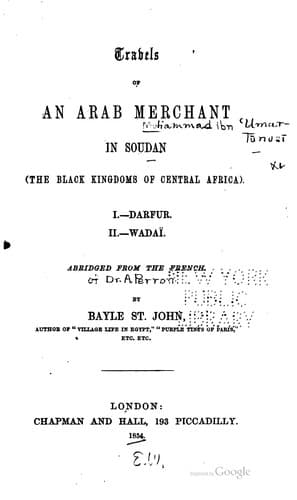
Travels of an Arab merchant in Soudan (the Black Kingdoms of Central Africa)Tūnisī, Muḥammad ibn ʻUmar
History
Travels of an Arab merchant in Soudan (the Black Kingdoms of Central Africa)
Tūnisī, Muḥammad ibn ʻUmar
Darfur (Sudan) -- Description and travel; Wadai (Sultanate) -- Description and travel
Very little instruction is given to children in Darfur. The reading
of the Koran, which is the only primary education, even in Egypt,
is very imperfectly spread. One of the reasons is, that the children
only go to evening-schools, for all day they are occupied in keeping
the flocks and herds. When evening comes on they take their slates
and go to school. Every one of them in his turn brings a fagot of
wood to make a fire with, and the scholars sit round, and by the
light of the flame pursue their studies for an hour or two. The
result is general ignorance. The country produces scarcely any
Ulemas, and those who do exist give but mediocre lectures on civil
and religious law, and on the proofs of the existence and unity
of God. Rational studies, that is to say, those which have for
their object the sciences of human invention—the liberal arts,
the humanities, &c.—are nearly null; a few individuals only
possessing a few simple notions on the Arabic grammar. The study of
the rules of Arab phraseology, that of the delicacies and varieties
of discourse, of tropes, of rhetoric, of logic, and versification,
is entirely neglected, except by a few who have gone to study at
Cairo. Great importance is attached, however, to the science of
demons and magic. Medicine, among the Forians, is a branch of magic,
which is cultivated most especially by the Fullans, or Fellatahs.
With reference to climate, Darfur is not equally salubrious
throughout its whole extent, and in all its provinces. The most
healthy part is the Gouz, or Country of Sand. The Arabs who inhabit
it, and breathe its pure air, are full of force and courage; but it
contains, unfortunately, little water. The most unhealthy country
for strangers is the Saïd; and, indeed, all the great capital towns
are remarkably unfavourable to health. In spite, however, of this
prevalence of disease, the people of Darfur love their country and
cherish their huts. However, it must be observed that, as there are
few epidemic diseases in Darfur, the population is tolerably well
kept up. Many men reach the age of a hundred, or even a hundred
and twenty; and very old people are common, despite of wars, and
domestic disturbances, and private quarrels. If it were not for
these causes, and the murders which are committed in a state of
drunkenness, or from jealousy, the population of Darfur would equal
in number the Yagog and the Magog, and the vastest plains would not
be able to contain it. Some may object that the women, not being
exposed to the same chances of death, ought to exist in greater
numbers; but I believe that grief for the loss of their husbands,
children, and relations, and the various privations and fatigues
they are subject to, prevent their excessive increase. However,
there are more old women than old men, even among the very poor. I
have remarked that, in this latter class, the misery is so great,
that the poor of our country would never be able to support it.
Public-domain text, read in full here on John Shaqi.
Reviews
Reviews
No reviews yet
Be the first to share your thoughts on this work.
Elsewhere in the archive
Join the Discussion
Join the discussion
Sign in to leave a comment or review.
Sign InorCreate an account