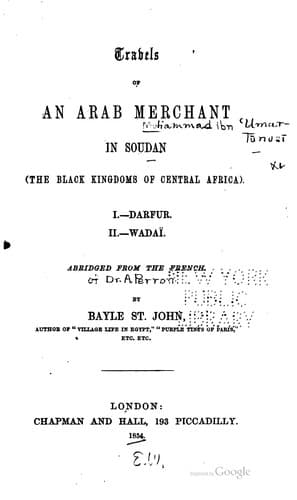
Travels of an Arab merchant in Soudan (the Black Kingdoms of Central Africa)Tūnisī, Muḥammad ibn ʻUmar
History
Travels of an Arab merchant in Soudan (the Black Kingdoms of Central Africa)
Tūnisī, Muḥammad ibn ʻUmar
Darfur (Sudan) -- Description and travel; Wadai (Sultanate) -- Description and travel
Food that is bitter and disgusting to us seems to the Forians
exquisite eating. A little time after my arrival a dish called
weykeh was set before me, and I was invited to eat; but this was
impossible. My father, hearing of this, said to me,—“He who
will not eat weykeh should not come into this country.” However,
for some time, he had prepared for me a few dishes that I liked,
such as rice and milk. When we went to the Fasher to visit the
Sultan, we were lodged by the Fakih Malik. At the first supper
a bitter mess was placed before me. I asked what it was, and was
answered,—“Weykeh, cooked with heglig.” I found it impossible
to touch it. Another dish was brought in, and with it came an
abominable stink. “What is that rotten stuff?” cried I. I was
told it was weykeh dandary, which was considered a great delicacy;
but I could not put a single morsel in my mouth, and so Malik was
obliged to send me some fresh milk sweetened with honey. In the
evening he asked me why I did not eat any of his dishes.
“The first,” said I, “was too bitter; and the second was
too stinking.”
“My friend,” replied he, “these kinds of dishes are necessary
for the preservation of health in our country, and whoever does
not eat them is in danger of disease.”
The dandary is prepared with the residue of bones of sheep and
oxen, which are thrown into a great vase full of water, and left
for several days, until they begin to smell strong.[22] Then they
are pounded in a mortar, and reduced to a sort of paste, of which
balls are made as big as oranges. To prepare a weykeh, one of these
balls is dissolved in water, strained and mixed with onions fried
in butter, with pepper, salt, and other condiments.
The common food of the poor is millet, not winnowed. Their cookery
is detestable; they use a salt extracted from wood-ashes. People a
little better off live, for the most part, on milk and butter. They
eat meat only from time to time, when an animal is killed, and sold
in portions for so many measures of millet. The young men often go
out hunting, and kill rabbits, hares, the gazelle, the wild ox, the
fox, and the teytel. The latter animal has the form and appearance
of a tame ox, but is not larger than a middle-sized calf. It has
a couple of horns, one or two spans in length, nearly straight,
and bent sometimes forward, sometimes backward. This animal is
remarkably stupid, and only flies if it sees a great crowd of
people; if one or two people draw nigh, it looks with a tranquil
eye and does not move. If the Forians meet a teytel standing still
in a plain, they generally cry, “Ya teytel, ya kafer!”—“O
teytel, O infidel!” The beast looks at them with indifference,
unless they endeavour to approach quite near. The teytel seems to
be a variety of the wild ox, but is smaller; its colour is fallow.
Public-domain text, read in full here on John Shaqi.
Reviews
Reviews
No reviews yet
Be the first to share your thoughts on this work.
Elsewhere in the archive
Join the Discussion
Join the discussion
Sign in to leave a comment or review.
Sign InorCreate an account