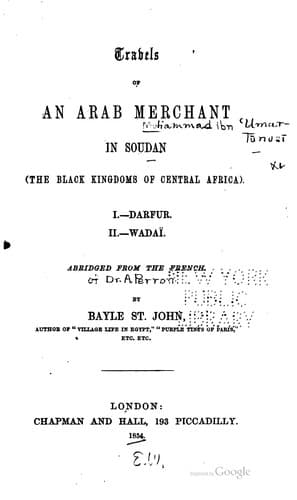
Travels of an Arab merchant in Soudan (the Black Kingdoms of Central Africa)Tūnisī, Muḥammad ibn ʻUmar
History
Travels of an Arab merchant in Soudan (the Black Kingdoms of Central Africa)
Tūnisī, Muḥammad ibn ʻUmar
Darfur (Sudan) -- Description and travel; Wadai (Sultanate) -- Description and travel
The Bedawin Arabs of Darfur and Wadaï are abundantly supplied with
everything necessary to support life. They derive from Darfur or
Wadaï only a little millet, some maize, and articles of costume. In
exchange for these they sell their surplus of butter, honey,
cattle, skins of wild or domestic animals, leather sacks, whips,
or cords. Most of them are wealthy in butter and in honey. The
latter is found in certain trees where the wild bees make their
hives. The chase supplies the Arabs with many advantages. Ostrich
feathers and rhinoceros’ horns are so plentiful with them as to be
of no value. When I was in Wadaï, a Fezzan merchant came there to
buy ostrich feathers, and applied to the Shereef, who had succeeded
my father as Vizier, for a letter of introduction to the Sheikh,
Shaw-shaw, chief of the tribe of Mahami, in order to induce him to
hunt the ostrich for a moderate price. The merchant had brought
fifty Frank ryals, or dollars. The Shereef wrote the letter for
the Fezzanee, who departed for the district where the tribe was
settled. On his return, he related to me his commercial expedition
in these words:—“When I arrived, I was conducted to the tent
of the Sheikh, Shaw-shaw, who received me with bounty and kindness,
and gave me a tent of camels’ hair, well furnished. He assigned to
me a male and female servant, who attended me in all things. I had
brought him a present, which he accepted with joy, giving me another
in exchange, and I handed over to him my fifty ryals. He called
together a certain number of his Arabs, and said to them,—‘This
man is my guest; he has come and confided himself to me, and wants
ostrich feathers. Let those who wish to gain some of these dollars
go forth to-morrow at dawn of day. Each zhalym-skin shall be paid
half a dollar, and each rabdah-skin a quarter of a dollar.’[23]
“Next day, accordingly, the Arabs went out and brought me
twenty zhalym-skins. I remained three weeks, and completed a
hundred. Shaw-shaw put them on his camels, and carried them for
me to Warah, the capital of Wadaï. He gave me, also, a plentiful
supply of provisions; as melted ostrich grease, honey, &c. At Warah
I sold nearly ninety zhalym-skins for three dollars each, so that,
without any fatigue, I gained a pretty profit.”
Milk is so plentiful in Arab encampments that they can never use the
whole, in spite of the quantity of butter they make, and are obliged
to throw away a large portion. In the districts of the Rezeigat,
the Red Masirieh, and others, the pools and ponds are all white
with milk.
Public-domain text, read in full here on John Shaqi.
Reviews
Reviews
No reviews yet
Be the first to share your thoughts on this work.
Elsewhere in the archive
Join the Discussion
Join the discussion
Sign in to leave a comment or review.
Sign InorCreate an account