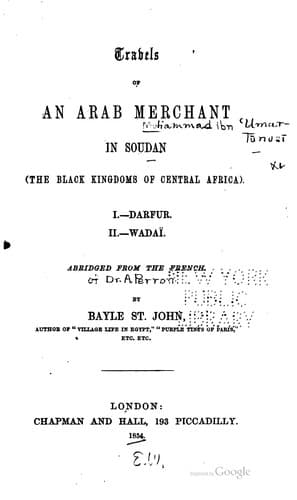
Travels of an Arab merchant in Soudan (the Black Kingdoms of Central Africa)Tūnisī, Muḥammad ibn ʻUmar
History
Travels of an Arab merchant in Soudan (the Black Kingdoms of Central Africa)
Tūnisī, Muḥammad ibn ʻUmar
Darfur (Sudan) -- Description and travel; Wadai (Sultanate) -- Description and travel
Very few of the natives of Soudan are able to distinguish gold
from copper, or tin from lead. Gold-dust is sometimes used,
however, as a medium of exchange. In Darfur there are absolutely no
precious metals but such as are imported from abroad, and even the
ornaments of women are principally composed of glass beads. It is
not astonishing, therefore, that the Forians remained long without
knowing the use of silver or gold coins. When commerce, however,
became extended, they were obliged to invent some kind of money,
and they first used rings of pewter, which they employed for the
purchase of daily necessities. For things of a greater price,
a long piece of stuff, about five yards long, and half a yard
wide, is used. Slaves have also a fixed monetary value, according
to their height. For example, a horse may be worth three or four
sedasy, or slave, who, from the heel to the lower lobe of the ear,
measures six spans. In Darfur are known neither the mahboub nor the
piastre, nor any kind of coin used in civilised countries, except
the abou-medfah, or pillar-dollar. In the chief towns glass beads
are used as money; and in the parts about Guerly they use the falgo,
or cake of salt, prepared in a particular manner. There are three
kinds of salt in Darfur,—the zaghawy, which is procured from
the lakes of the same name; the falgo, which is of a grey colour,
opaque, and rather agreeable to the taste; and the mydaoub, which
is of a blood-red colour, and by far the best. At Krousa tobacco
is used as money, and is called taba. It is pounded into a paste,
and made up into hollow cones, about the size of a pear. By the way,
I have read a piece of verses composed by one of the descendants of
the Kaliph Abou-Bekr, the object of which is to prove that smoking
is not a sin. These verses date from about the middle of the ninth
century of the Hegira. I shall extract one or two verses:—
“The all-powerful God has produced from the soil of our country
a plant, the true name of which is tabgha.
“If any one in his ignorance maintains that this plant is
forbidden, say to him, ‘How do you prove it? By what verse of
the Koran?’
“This plant does not inebriate, and this is why God has not
condemned it. Whence hast thou taken thy word of condemnation?
“If thou inspirest the smoke of the tabgha, it rejoices and solaces
thee; but never forget to say before the first puff,—B’ism Illah,
in the name of God.
“And when thou hast finished, give praise to the single God,
and this will bring upon thee abundant blessings.”
In some places little bundles of cotton-twist are used as money, and
at others strings of onions. At one market the iron head of a kind
of hoe is employed; and in the Gouz the same purpose is served by
handfuls of millet. In many places the measure of value is an ox; and
they say, for example, “this horse is worth ten or twenty oxen.”
CHAPTER X.
Public-domain text, read in full here on John Shaqi.
Reviews
Reviews
No reviews yet
Be the first to share your thoughts on this work.
Elsewhere in the archive
Join the Discussion
Join the discussion
Sign in to leave a comment or review.
Sign InorCreate an account