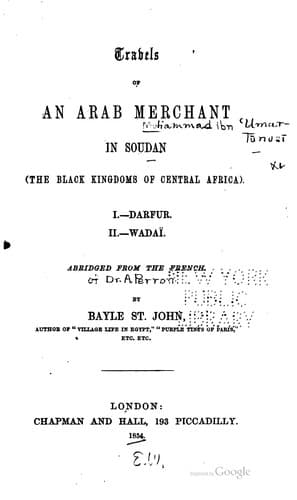
Travels of an Arab merchant in Soudan (the Black Kingdoms of Central Africa)Tūnisī, Muḥammad ibn ʻUmar
History
Travels of an Arab merchant in Soudan (the Black Kingdoms of Central Africa)
Tūnisī, Muḥammad ibn ʻUmar
Darfur (Sudan) -- Description and travel; Wadai (Sultanate) -- Description and travel
Among the remarkable plants is the kyly, which produces the fruit
from which is made the ordeal liquor of which I have already
spoken. The leaves of the shalob, when chewed, take away the
taste of wine from the mouth. The dagarah is used as a medicine in
ophthalmia. I once was at the market of Numleh, and, having handled
pepper incautiously, put my hand to my eyes; a severe pain and
great swelling came on, and I was obliged to stop at a village and
go into an old woman’s house, suffering dreadfully. My hostess,
however, sent for some leaves of the dagarah, pounded them in a
mortar, and dropped the juice upon my eyes, and I was cured by one
or two applications.
The greater part of the trees and other vegetables of Darfur have
their fruit ripe towards the end of autumn, which corresponds
to the end of summer in Egypt. The rains begin at the beginning
of their autumn; and I have learned from various points that it
is these rains which assist in swelling the river Nile. In 1841
of the Christian era the great Kadi of Wadaï told me that 1837,
the year of famine in Egypt, was signalised by an extraordinary
drought in his country. The rainy season is ushered in by great
wind-storms, which roll enormous clouds from the east, raising
also vast columns of sand from the plains of the Gouz. The horizon
becomes also of a blood-red colour. Rain always follows, accompanied
by thunder. During the whole of the season prodigious showers fall,
accompanied by violent thunder-claps. When the lightning falls it
commits great destruction. I have seen branches torn away from great
trees, huts burnt down, and a man’s arm broken. The Forians say
that those who carry iron about them are never struck, which is
exactly contrary to the opinion of the Europeans.
During the Darfur summer great winds prevail, which raise enormous
clouds of dust, and vast mirages inundate the plains. It has been
noticed that the showers which fall during the night are much more
gentle than those that fall by day. Rainbows are common; I have
seen five or six at the same time, some rising straight up in the
air. The rains last about sixty days; if less, there is famine. In
Darfur and Wadaï the names of the months are of Arab origin,
without any reference to the denominations used by the Greeks,
the Copts, or the Europeans.
I shall now say something of the marvellous qualities of some plants
of Darfur. I do so with some hesitation, fearing to be accused
of falsehood; but there are some extraordinary things which must
be told. The chief properties of these magic plants are in the
roots. There exist in Darfur master-herbalists, who have scholars
under them. They unite from time to time to go on expeditions,
and climb the mountains, and plunge into the valleys in search of
plants. They are called in Darfur, Magicians, and enjoy a certain
reputation. They are all in rivalry one against another, and in
strong competition. They keep their roots in horns of goats, rams,
or oxen.
Public-domain text, read in full here on John Shaqi.
Reviews
Reviews
No reviews yet
Be the first to share your thoughts on this work.
Elsewhere in the archive
Join the Discussion
Join the discussion
Sign in to leave a comment or review.
Sign InorCreate an account