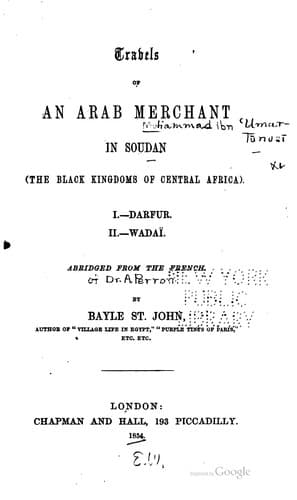
Travels of an Arab merchant in Soudan (the Black Kingdoms of Central Africa)Tūnisī, Muḥammad ibn ʻUmar
History
Travels of an Arab merchant in Soudan (the Black Kingdoms of Central Africa)
Tūnisī, Muḥammad ibn ʻUmar
Darfur (Sudan) -- Description and travel; Wadai (Sultanate) -- Description and travel
It is also related that some people have the power of paralysing
whoever attempts to attack them. But the most extraordinary facts
are those which are related of the Massalits and the Temourkehs,
who have the power of metamorphosing themselves into different
kinds of animals. All the Forians say that the former can change
into hyænas, cats, and dogs, and the latter into lions. Another
extraordinary thing related of the Temourkehs is that, according to
their own account, three days after their death, they resuscitate
and come out of their tombs, and go into other countries to marry
again, and accomplish a second life.
In Darfur, every one acknowledges that the Sultan has under
his orders a number of men having the power of metamorphosing
themselves. They are used as agents and ambassadors. If they are
in danger of being seized, they transform themselves into air
or wind. I once became very intimate with one of these people,
and at length ventured to speak on the subject of his wonderful
power, but he turned aside the conversation, and avoided a direct
answer. Another time I pressed the question closer, upon which
he smiled and said:—“I did not think you were so simple as to
believe all that is said on this subject.” Then he talked of other
things, and soon left me, and from that time forward, whenever he
met me he turned aside, and our acquaintance utterly ceased.
I was once following a Ghazwah, or slave-hunt, directed against
the Fertyts by a king. As he owed me a debt, he took me with him
to pay me from the slaves he was to capture.[26] We advanced far
into Dar-Fertyt, and remained there three months, in a place without
fruits or vegetables. One day the king sent for me, and I found him
surrounded by green onions and long cucumbers, as fresh as if just
plucked from the garden. I asked who had given them to him?
“They arrived from Darfur,” said he.
“Who brought them? and how can their freshness have been
preserved?”
“They have been transported hither in an instant—look at this
letter, and see the date of it.”
I took the letter, and found that it was from one of his friends
in Darfur, and that it was dated the same morning.
“Do not be so surprised,” said the king, “for we have with us
men of Temourkeh, who have the faculty of transforming themselves
as they please, and of traversing the greatest distance in a very
short period of time.”
“I should wish,” said I, “to see some of these people.”
“You shall,” said he; and accordingly, on our return, we passed
through a village of the Temourkehs, and stopped there to pass the
night. In the morning the people came to visit the king, and the
chief said to him,—
“I beg, if you see any lions on your way, not to attack them,
for they are our companions metamorphosed.”
“But,” said the king, “I should like to hear some of them
roar.”
Public-domain text, read in full here on John Shaqi.
Reviews
Reviews
No reviews yet
Be the first to share your thoughts on this work.
Elsewhere in the archive
Join the Discussion
Join the discussion
Sign in to leave a comment or review.
Sign InorCreate an account