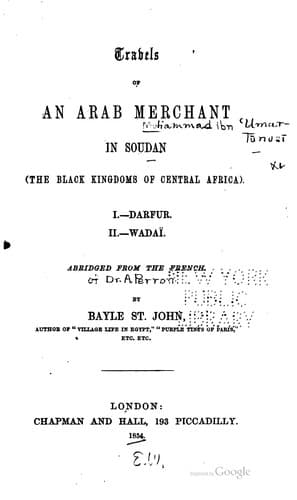
Travels of an Arab merchant in Soudan (the Black Kingdoms of Central Africa)Tūnisī, Muḥammad ibn ʻUmar
History
Travels of an Arab merchant in Soudan (the Black Kingdoms of Central Africa)
Tūnisī, Muḥammad ibn ʻUmar
Darfur (Sudan) -- Description and travel; Wadai (Sultanate) -- Description and travel
However, every day new additions were made to our company; troops of
men came flocking in from all sides; and our encampment resembled
that of an army. One morning he looked abroad and saw that he
had sufficient strength, and ordered the camels to be laden, and
gave the signal of departure. It was still early when we started;
our caravan was placed in the middle of the army, which marched
in one mass. Presently we got beyond the cultivated country, and
entered the uninhabited districts which separate, like a wall,
Darfur from Wadaï. In this wilderness we beheld an innumerable
quantity of wild animals, from the elephant down to the gazelle and
the hare. The hares, frightened by the noise we made in marching,
started up from their covers, and flying on all sides, as if blind,
came some of them into the midst of the soldiers, who killed them
nearly at their feet. A great number of gazelles and other animals,
bewildered by this invasion of their territory, were killed without
trouble. The army amused itself thus with hunting until the great
heat of the day had passed, when the king set up his tent, and all
by degrees followed his example. Fires were lighted over the whole
surface of the plain, and all the game taken was roasted. The meal
finished, and the heat somewhat subsiding, we again set out; but
suddenly our progress was arrested, and the vacillating governor
rode up and informed us that he intended to return. I alone dared
to make an objection. “If thou returnest,” said I, “we will
return with thee. We will not remain here, unescorted, in the midst
of these solitudes.” He endeavoured to excuse himself, alleging
his numerous occupations, but we insisted that our safety should
be provided for. Then he gave us one of his suite as a guide, with
an escort of fifty or sixty horsemen, and told him to accompany us
until we were in safety, and until we sent him away. Then we bade
adieu to the king, who immediately set off at a gallop, followed
by the great mob of his army, and returned towards his country,
and as we pursued our way in the other direction their murmur
and trampling soon no longer came to us, and the last stragglers
disappeared amidst the trees. Our guide escorted us for some hours,
and then pulled up and told us that he intended to leave us. We made
what opposition we could, and repeated to him over and over again
that we were without means of defence; that four armed men would
be sufficient to destroy us; and that, if anything happened to us,
our blood would be upon his head. “Nay,” said he, “I will
not proceed, for you are now near the cultivated lands of Wadaï;
and we are afraid, on account of our enemies. If they perceive us,
blood will be spilt, and it will be your fault.” We conjured him
in the name of all the saints and of all the prophets, and exerted
ourselves to persuade him to accompany us a little farther. He
yielded; but scarcely had he escorted us a quarter of an hour more
Public-domain text, read in full here on John Shaqi.
Reviews
Reviews
No reviews yet
Be the first to share your thoughts on this work.
Elsewhere in the archive
Join the Discussion
Join the discussion
Sign in to leave a comment or review.
Sign InorCreate an account