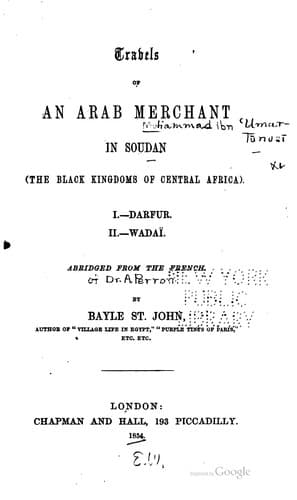
Travels of an Arab merchant in Soudan (the Black Kingdoms of Central Africa)Tūnisī, Muḥammad ibn ʻUmar
History
Travels of an Arab merchant in Soudan (the Black Kingdoms of Central Africa)
Tūnisī, Muḥammad ibn ʻUmar
Darfur (Sudan) -- Description and travel; Wadai (Sultanate) -- Description and travel
Next evening the Sultan sent seven more tubs, and an equal number the
following day. On the third day Nasser and the first interpreter
of the Sultan came to see us, and I gave to them my presents
for his majesty. These presents were very humble; consisting,
among other things, of ten pounds of yemen coffee, in the berry,
ten pounds of soap, and two rings of latten, weighing each two
pounds. My offerings, though of slight value, were accepted
graciously, on account of the respect the prince bore my father;
and on the evening of the same day a eunuch came from the Sultan,
and presented me with a large parcel and two young female slaves,
one still a virgin, but the other, who was not so, much handsomer
and better dressed. I returned my thanks, and we recited the Fatha
in honour of the Sultan. On the following morning another eunuch
came, accompanied by several individuals and by laden camels,
bringing fresh presents. These consisted of five jars of honey,
ten jars of butter, two loads of wheat, a load of salt fish, a
load of tekaki, or parcels of thread or cotton used as money, a
grey horse, saddled and bridled, fed by a slave, seven spans high,
and two women-slaves, as servants. We expressed our gratitude,
and uttered sincere prayers for the Sultan. In the packet I have
mentioned were found two garments of the finest tissue, one black and
one white, each worth at least the price of two slaves, and a piece
of English calico. Besides all these things, I received two bulls,
ready for killing, and a young she-camel. From time to time other
presents were sent me; among others, a couple hundreds of eggs of the
speckled hen. In Wadaï these hens live wild, and lay in the spring,
when the peasants collect immense quantities of eggs. It is customary
every year for each canton to send to the Sultan at least a hundred
camel-loads, which are generally distributed to the courtiers.
I had been four months in Wadaï without having seen, or been seen,
by the Sultan. An accident caused my reception. According to the
decrees of God, my hand was burnt by an explosion of gunpowder. The
Sultan learned my misfortune, and was told I suffered dreadfully;
so he sent me a jar of olive-oil, which had been preserved for
more than sixty years, and had acquired a red tint and bitter
taste. This oil was my salvation, for by it God cured me. I went
to the mosque to pray, and was afterwards sent for to the palace
by the Sultan, who received me with benevolence. He recommended
me to pursue my studies, and advised me to put myself under the
teaching of Sheikh Seid Ahmed, who was at that time giving lessons
of civil and religious law at Warah. I did so for some time, and
read several learned books; but a misunderstanding with the Sheikh
caused me to abandon these studies and his society.
CHAPTER II.
Public-domain text, read in full here on John Shaqi.
Reviews
Reviews
No reviews yet
Be the first to share your thoughts on this work.
Elsewhere in the archive
Join the Discussion
Join the discussion
Sign in to leave a comment or review.
Sign InorCreate an account