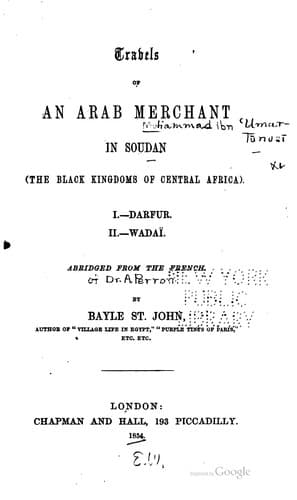
Travels of an Arab merchant in Soudan (the Black Kingdoms of Central Africa)Tūnisī, Muḥammad ibn ʻUmar
History
Travels of an Arab merchant in Soudan (the Black Kingdoms of Central Africa)
Tūnisī, Muḥammad ibn ʻUmar
Darfur (Sudan) -- Description and travel; Wadai (Sultanate) -- Description and travel
Other persons told me that the Sultans of Wadaï, Darfur, and
Kordofal, were all descended from one father, who belonged to the
Arab tribe called Fezarah; but as all these recitals are founded
on mere oral traditions, God only knows the truth. For my part, I
am inclined to believe the account which derives the great Seleih
from the Abbasides, on account of the elevation of his character,
the nobility of his mind, his piety, and his goodness. If he had
preceded Hatim Tai by a day, Hatim would never have been chosen as
the type of generosity in Arab poetry. How different is the paltry
conduct and the poltroonery of the Forians from the valour and the
easy hospitality of the Wadaïans! The differences of the qualities
of the two nations are sufficient to prove the different origin
of their Sultans; for a people is, in some sort, the creation of
its governors. At any rate, one thing is certain, that the three
states of Wadaï, Darfur, and Kordofal, are of recent establishment,
not exceeding in age two hundred years.
An old man of Senoun once related to me that Salou Selman, sultan
of Darfur, and Seleih, sultan of Wadaï, once met in the uninhabited
space which separates the two countries, and there engaged, by oath,
to live in peace one with the other. They measured the space between
the cultivated land, and drew a line exactly in the centre, which
they marked by very long and thick iron nails, driven into the trunks
of the largest trees. They engaged reciprocally not to overpass this
line with hostile intentions, and called God and man to witness what
they promised. When I was travelling from Darfur to Wadaï, indeed,
I saw in the midst of the forest, at the place where we met so great
a number of rabbits and wild beasts, a line of trees, in each of
which a bar of iron was stuck, advancing about a span. Each nail
appeared to me about a cubit and a half long. The points did not
stick out straight, but were beaten down, to prevent any accidental
injuries to passers-by. The Fakih Ahmed told me at that time that
this was the ancient boundary-mark of Wadaï and Darfur.
After the death of the two wise Sultans, their children, as is
the custom with princes, began to cast covetous eyes on their
neighbour’s property. He of Wadaï invaded Darfur, but was
defeated with great loss, and under the next reign the Forians
penetrated into Wadaï. The war that followed was most terrible,
and in one of the battles the Forian Sultan himself was slain. The
whole of this struggle reminds me of the war of Basous. The corpses
of those who fell were devoured by birds of prey and by lions,
or buried in huge pits.
Public-domain text, read in full here on John Shaqi.
Reviews
Reviews
No reviews yet
Be the first to share your thoughts on this work.
Elsewhere in the archive
Join the Discussion
Join the discussion
Sign in to leave a comment or review.
Sign InorCreate an account