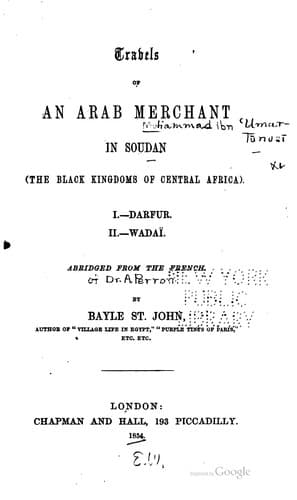
Travels of an Arab merchant in Soudan (the Black Kingdoms of Central Africa)Tūnisī, Muḥammad ibn ʻUmar
History
Travels of an Arab merchant in Soudan (the Black Kingdoms of Central Africa)
Tūnisī, Muḥammad ibn ʻUmar
Darfur (Sudan) -- Description and travel; Wadai (Sultanate) -- Description and travel
But I afterwards observed, on the seal of the reigning Sultan,
these words,—“The Sultan Mohammed, son of the Sultan Seleih,
the Abbaside.” I sought to find out by what genealogical
affiliation the name of that noble family could be mixed up with
the history of these non-Arab peoples. But those whom I consulted
gave me contradictory accounts, some saying that the reigning
dynasty had no connexion with the Arabs, others affirming the
contrary. A very sagacious person, the Aguid Ahmed, related to me,
that when the Tartars had driven the Abbaside family from Bagdad,
the kaliphate was removed to Egypt, and remained there until the
Turks and the Mamlouks drove them out; that is to say, until the
time of the Fatamites. The children of the Abbaside kaliphs, after
the overthrow of their dynasty, were dispersed, and sought refuge
in various countries. One of them went to Sennaar, and thence passed
on to Wadaï, where he settled among the Pagan inhabitants of Mount
Seloun. He fulfilled exactly the duties of his religion, praying,
fasting, and performing the zikr and reciting the Koran. The people,
whose friendship he had acquired, asked him why he did these things,
and he answered, it was to do homage to God. “And what is God?”
said they. “God is he who created the heavens and the earth,
the night and the day, the sun, and the moon, and the stars, the
trees and the rivers; his hand governs all these things.” The
people of Seloun at length embraced Islamism, and Saleh, whom they
called Seleih, after having well-instructed them, caused himself to
be named the religious chief, and set about converting by arms, or
other means, the neighbouring tribes. The four tribes first converted
became, in some sort, the royal family of the country, from which
the mothers of the Sultan must necessarily be derived. Such of the
remaining peoples of Wadaï as accepted the new faith with readiness
were declared to be free; whilst those who only yielded to force
were reduced to slavery. In this way, according to this informant,
was the dynasty of Seleih founded.
Public-domain text, read in full here on John Shaqi.
Reviews
Reviews
No reviews yet
Be the first to share your thoughts on this work.
Elsewhere in the archive
Join the Discussion
Join the discussion
Sign in to leave a comment or review.
Sign InorCreate an account