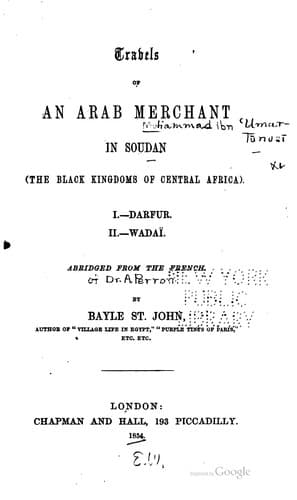
Travels of an Arab merchant in Soudan (the Black Kingdoms of Central Africa)Tūnisī, Muḥammad ibn ʻUmar
History
Travels of an Arab merchant in Soudan (the Black Kingdoms of Central Africa)
Tūnisī, Muḥammad ibn ʻUmar
Darfur (Sudan) -- Description and travel; Wadai (Sultanate) -- Description and travel
These preparations alarmed the viziers, who went to Seleih,
and represented to him that his son was making ready for an open
revolt. He accordingly ordered Saboun to be brought before him, and
one of the chiefs of the Turguenaks was sent to arrest him. These
Turguenaks, who are also called Osban, are the instruments of the
anger of the Sultan, and are always employed to effect important
arrests. It happened that Saboun was sitting on his Tirgeh, a kind of
platform, on a mound of earth, raised within the great enclosure of
a palace. He descried the Turguenaks from afar off, and, collecting
his people in time, prepared for resistance. It was, therefore,
impossible to arrest him, and sufficient time was given for the
anger of the Sultan to die away. He took counsel of his Ulemas,
and other wise people, and the result was that Saboun’s innocence
was made manifest, and he was suffered to live in quiet.
Some months after this event the Sultan fell seriously ill. His
chief wife, who had borne no children, fearing that the throne would
fall to Ahmed or Asyl, who had not the high qualities of Saboun,
and who would certainly have deprived her of her title of queen,
or, perhaps, put her to death, sent a secret messenger to the heir,
announcing that his father was ill. He immediately collected his
partisans in the villages in the neighbourhood of Warah, which
word corresponds to the Fasher of the Forians, and waited for the
event. When the Sultan died, the queen despatched a messenger to
Saboun, telling him, that unless he acted that very night all would
be lost, and that he must appear before the gates of the palace
two hours after sunset. The sagacious prince collected his force
accordingly, and appeared at the appointed time at the Warah. The
great difficulty was to force the Iron Gate, which is the fourth of
the seven gates. But, by a stratagem, the Fakih Mousa had obtained
admission, and was ready to open. The guards were asleep. Saboun,
with a few of his friends, advanced with naked feet on tip-toe until
he reached the fourth gate; his signal was understood, and Mousa,
who had won the confidence of the porter, and had taken the key,
immediately went and opened.
“For whom dost thou undo the gate at night?” said the porter.
Mousa did not reply, and Saboun passed silently with his troop. The
Fakih then seized a lance which belonged to the porter, who was
half asleep, and said to him,—
“Dost thou know for whom I have opened the door?”
“No.”
“For thy master—the master of thy mother and thy father.”
Public-domain text, read in full here on John Shaqi.
Reviews
Reviews
No reviews yet
Be the first to share your thoughts on this work.
Elsewhere in the archive
Join the Discussion
Join the discussion
Sign in to leave a comment or review.
Sign InorCreate an account