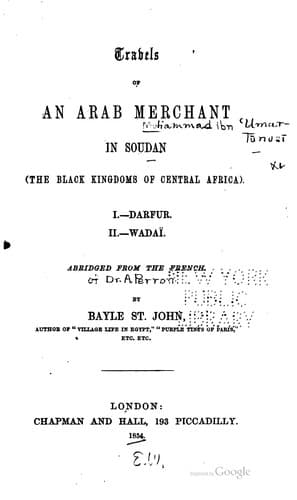
Travels of an Arab merchant in Soudan (the Black Kingdoms of Central Africa)Tūnisī, Muḥammad ibn ʻUmar
History
Travels of an Arab merchant in Soudan (the Black Kingdoms of Central Africa)
Tūnisī, Muḥammad ibn ʻUmar
Darfur (Sudan) -- Description and travel; Wadai (Sultanate) -- Description and travel
So saying, Mousa stabbed the porter, and then, falling upon the
guard, struck right and left, and killed fifteen of them. Saboun
had collected a considerable force without, and about five hundred
men entered after him and joined Mousa in the carnage. The people
of the palace, on waking up, met with lance-thrusts hotter than
burning coals. Some defended themselves desperately to the death,
whilst others submitted. By the blessing of God some huts took fire,
so that the Prince Saboun was enabled easily to recognise his enemies
and make a horrible massacre of them. The guards of the palace came
running forth to escape from the flames, and a great number were put
to the sword. Without this conflagration to light up the carnage,
Saboun might have been struck by a traitor-hand and have perished.
When the prince, by these means, saw that he was master of the
palace, and delivered from all danger, he entered the chamber where
were laid out the remains of his father. The corpse was decorated
and adorned, and surrounded with the women of the harem. Saboun
shed some tears, and said, “May God set to my account in heaven
the misfortune that has befallen me—the death of my father!”
Having made this pious observation,[27] he demanded the insignia
of the Sultanship, that is to say, the imperial seal—a heirloom
transmitted from sovereign to sovereign—the imperial sabre,
the amulet, and the throne or seat of the Sultan. Very shortly
all these objects were brought, except the seat, which the women,
being hostile to the turn things had taken, would not at first give
up. However, by threats and promises, Saboun succeeded in obtaining
this precious article.
Meanwhile the combat continued without, and grew hotter and
hotter. The Turguenaks, by this time being wide awake, attacked the
soldiers of Saboun, who fell upon them with fury. The viziers of
the opposite party came up, but were repulsed. The fight lasted the
whole night, when the people of Saboun, having the upper hand, were
joined by the vacillating, and tranquillity was at length restored.
The Princes Ahmed and Asyl, who had been journeying through the
provinces, wantonly oppressing the people, came up next day at
the head of an army, but were defeated and put to flight. Saboun
thereupon gave thanks to God for his victory, and, appearing in the
divan, caused himself to be recognised as chief of the state. He
distributed all the important offices to his relations, and the
whole of Wadaï submitted to him, partly from affection and partly
from fear.[28] The rout of Ahmed and his partisans stifled the
expression of malevolence. The number of the dead was considerable,
and blood had flowed in abundance. A poet has well said, “Men of
great power cannot escape from danger unless they surround themselves
with an ocean of blood.”
Public-domain text, read in full here on John Shaqi.
Reviews
Reviews
No reviews yet
Be the first to share your thoughts on this work.
Elsewhere in the archive
Join the Discussion
Join the discussion
Sign in to leave a comment or review.
Sign InorCreate an account