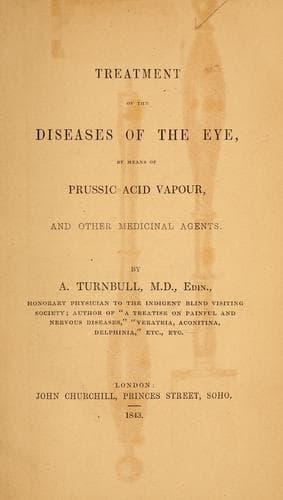
Treatment of the diseases of the eye, by means of prussic acid vapour, and other medicinal agentsTurnbull, Alexander
Science
Treatment of the diseases of the eye, by means of prussic acid vapour, and other medicinal agents
Turnbull, Alexander
Eye -- Diseases; Hydrocyanic acid -- Therapeutic use
"MRS. M'BEATH. Suffered for many years past from a disease combining
the characters of conjunctival and sclerotic ophthalmia. The prussic
acid was applied, daily, for about three weeks, and at the expiration
of that time the redness and angry appearance of the eye disappeared;
the organ looked clear and healthy, and no pain whatever was felt. The
patient can bear a bright light without uneasiness, and is now free
from any symptom of her former ailment.
"Thurso, Caithness, Dec. 20, 1842."
Extracted from the _London Medical Gazette_, of January 13th, 1843:--
PRUSSIC ACID IN DISEASED CORNEA.
"_To the Editor of the Medical Gazette._
"Perth, December 31st, 1842.
"SIR,--If you deem the following case of diseased cornea, &c., worthy
of a place in the _Medical Gazette_, I shall feel myself obliged,
while I have the honour to be, &c. &c.,
"G. K. H. PATERSON,
"Surgeon."
"CASE.--M. J., æt. 29, of a strumous diathesis, has been repeatedly
attacked with inflammation in both eyes alternately, accompanied with
more or less intolerance of light, and pain of head, ever since she had
small-pox, about her ninth year: to relieve this her friends sought
various means, but without any avail, and on entering her eighteenth
year she became blind. The catamenia had never appeared before she
was twenty; and from that period onwards, till about four years ago,
menstruation had always been scanty, and attended with the usual
symptoms of dysmenorrhœa.
"On the 28th September, 1842, her eyes presented the following
state:--The right cornea transparent, with an unusual quantity
apparently of aqueous humour on the anterior chamber, so as to give
it externally a somewhat conical aspect; iris of a dark red colour,
and its pupillary edge contracted to the size of a pin-hole, and in
close contact with the capsule of the lens. No vision in this eye
remaining. That of the left cornea was all but opaque, from coagulated
lymph between its layers, with the exception of a small lucid segment,
at the upper and outer margin of its circumference; behind which, on
the eye being turned downward and inward, the pupil could be seen
contracted also, and of an oblong shape, along with a great increase of
aqueous humour in the anterior chamber, and the cornea, to external
appearance, much more bulged forward than that of the right. With this
eye she could only distinguish an object when it was rolled downward
and toward the inner canthus, on being passed between her and the light.
Public-domain text, read in full here on John Shaqi.
Reviews
Reviews
No reviews yet
Be the first to share your thoughts on this work.
Join the Discussion
Join the discussion
Sign in to leave a comment or review.
Sign InorCreate an account